Derby sits on the Trent Valley floodplain, where the alluvial sands and gravels can be loose and prone to settlement under load. We've seen it time again on industrial plots near the A38: ground that looks firm but gives way once you stack pallets or pour a concrete slab. That's where vibrocompaction design comes in. Instead of excavating and replacing metres of soil, we densify it in place using a vibrating probe, typically to depths of 6 to 12 metres. The result is a uniform, high-density deposit that meets bearing capacity requirements without the cost of deep piling. For projects on the Pride Park or Sinfin corridors, this method has saved clients both time and money. Before we specify the probe pattern and energy levels, we always run a site investigation to map the soil profile — often including a CPT for continuous stratigraphic logging.
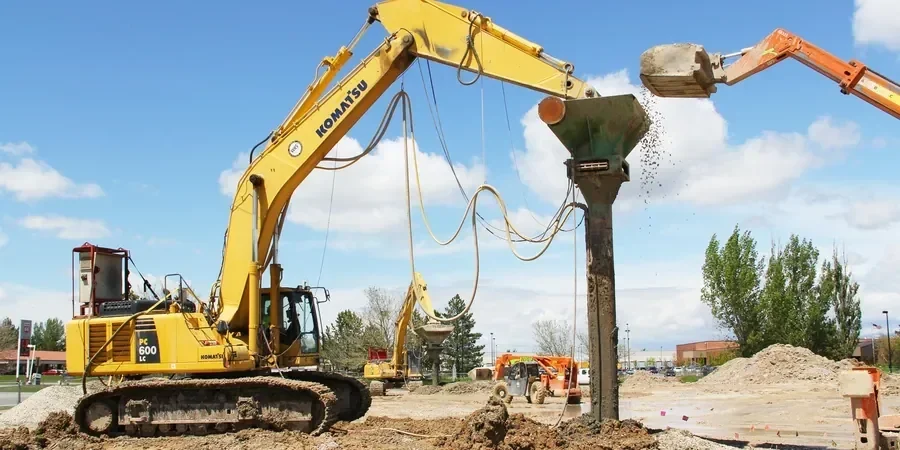
We densify loose soil in place using a vibrating probe, typically to depths of 6 to 12 metres — no excavation, no imported fill.
Process overview
Local context
Eurocode 7 (EN 1997-1:2004) and BS 5930:2015 govern our vibrocompaction design in Derby. The main risk in this city is heterogeneous ground — you can have loose sand next to dense gravel within a few metres. If the design assumes uniform conditions but the probe hits a stiff layer earlier than expected, the compaction energy may not reach the target zone. That's why we always run a pre-treatment CPT with continuous logging, and we keep the probe pattern adaptable on site. We've also seen cases where groundwater is high during wet months, which reduces the effective stress and slows densification. To mitigate that, we schedule the work during summer and use a temporary pumping system if needed. The team holds ISO 9001:2015 certification and follows the ICE Specification for Ground Treatment.
Regulatory framework
Eurocode 7 (EN 1997-1:2004), BS 5930:2015 – Code of practice for ground investigations, ICE Specification for Ground Treatment (2017)
Additional services
Vibrocompaction Design – Loose Sands & Gravels
For sites with thick deposits of loose granular soil, we calculate the probe grid, energy input, and backfill specification to achieve a target relative density of 75% or higher. Includes pre-treatment CPT and post-treatment plate load tests.
Vibrocompaction Design – Variable Ground Profiles
Where the soil profile changes rapidly — common in Derby's river terrace deposits — we design a flexible pattern with real-time monitoring to adjust depth and spacing as the probe meets different layers. Ideal for brownfield sites with unknown fill.
This service complements our laboratory testing work for a complete project analysis.
Typical parameters
Questions and answers
How much does vibrocompaction design cost in Derby?
For a typical 5,000 m² industrial site in Derby, the design and supervision package ranges between £990 and £3,610 depending on the number of test points, depth of treatment, and monitoring requirements. The figure includes pre-treatment CPTs, design report, and post-treatment verification.
What ground conditions make vibrocompaction unsuitable in Derby?
Vibrocompaction works best in clean sands and gravels with less than 15% fines. If the site has high clay or silt content — like the Mercia Mudstone zones north of the city — the vibration energy dissipates and densification is poor. In those cases we recommend dynamic compaction or stone columns instead.
How long does the vibrocompaction design process take?
From site investigation to final design report, expect 10 to 15 working days for a straightforward plot. If we need to run trial probes and adjust the pattern, it extends to three weeks. The actual compaction work on site usually takes 1 to 2 weeks for a 5,000 m² area.
Do you need planning permission for vibrocompaction in Derby?
Vibrocompaction is generally permitted under permitted development rights for industrial and commercial sites, but it produces vibration and noise. Derby City Council may require a prior notification if the site is near residential areas or listed buildings. We help clients submit the necessary documentation to the council.