Derby sits on a varied geological setting, with Triassic Mercia Mudstone forming the bedrock beneath much of the city. Overlying this are significant deposits of glacial till and river terrace gravels along the Derwent Valley. In many areas, weathering of the mudstone has produced variable residual soils, often with high clay fractions and distinct plasticity profiles. These weathered horizons require careful characterization to avoid costly surprises during excavation and foundation work. Our team has extensive track record assessing these specific ground conditions across Derby, from the city centre developments near the Cathedral Quarter to the industrial estates along the A38 corridor. A thorough residual soil characterization in Derby is essential for any project where load-bearing capacity relies on the weathered zone.
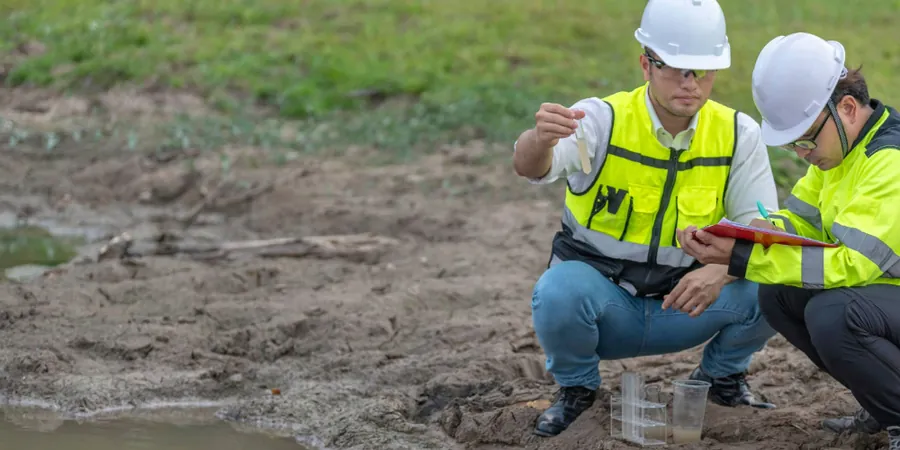
The upper weathered zone of Mercia Mudstone in Derby often shows plasticity indices exceeding 30 percent, demanding site-specific testing.
Process overview
- Plasticity indices often exceed 30 percent in the upper weathered zone.
- Shear strength can drop sharply with increasing saturation.
- We combine classification with corte directo to measure drained strength parameters on undisturbed samples.
Local context
Compare the residual soils under a site in Mickleover versus one in Chaddesden. In Mickleover, the weathered mudstone tends to be firmer with lower plasticity, while Chaddesden often shows deeper clay-rich zones with higher moisture content. This variability means that a single borehole per plot is rarely sufficient. Without proper characterization, differential settlement can occur between adjacent structures. The risk is amplified in Derby because the residual soil thickness can vary from less than one metre to over five metres within the same development. Our characterization pinpoints these transitions, allowing engineers to adjust foundation depths or specify Improvement where needed.
Visual overview
Regulatory framework
BS 1377-2:1990 (classification tests), BS EN 1997-2:2007 (Eurocode 7 – Ground investigation), BS 1377-2 (Atterberg limits)
Additional services
Field Sampling & Logging
Window sampling and trial pits to recover undisturbed block samples from the weathered zone. Detailed logging following BS 5930:2015.
Laboratory Classification Suite
Full Atterberg limits, particle size distribution (wet sieving and hydrometer), natural moisture content, and density. UKAS accredited procedures.
Strength & Compressibility Testing
Undrained triaxial (UU) and drained direct shear tests on residual soil specimens. Oedometer consolidation for settlement assessment.
Typical parameters
Questions and answers
Why is residual soil characterization important for construction in Derby?
Derby's weathered Mercia Mudstone can vary significantly in thickness and plasticity over short distances. Without proper characterization, foundations may track record differential settlement or bearing capacity failure. Our testing identifies these variations early.
What is the typical cost range for residual soil characterization in Derby?
For a standard residential plot with two sampling points and full laboratory classification, costs typically range between £600 and £2,690 depending on depth and the number of tests required.
How deep should I sample residual soils in Derby?
Sampling should extend through the weathered zone into competent mudstone or until consistent refusal. In Derby, this often means depths between 3 and 8 metres below ground level, confirmed by SPT refusal criteria.
Can residual soil characterization help with pavement design in Derby?
Yes. The high plasticity and moisture sensitivity of residual soils directly affect CBR values and subgrade modulus. Our characterization provides the parameters needed for pavement thickness design to BS 13285 or local highway standards.