Derby’s industrial growth from the 18th century onward, driven by the railways and Rolls-Royce, shaped a city built over variable alluvium and glacial till along the Derwent Valley. These legacy fills and heterogeneous soils demand careful ground treatment before any new foundation work. Grouting design in Derby addresses the challenge of sealing voids in made ground and controlling seepage through sandy gravels beneath the city centre. Before specifying injection parameters, engineers typically verify soil classification through a granulometría to determine particle size distribution and a corte directo to assess shear strength at the interface. These preliminary tests inform the grout mix and injection pressure required for a durable result.
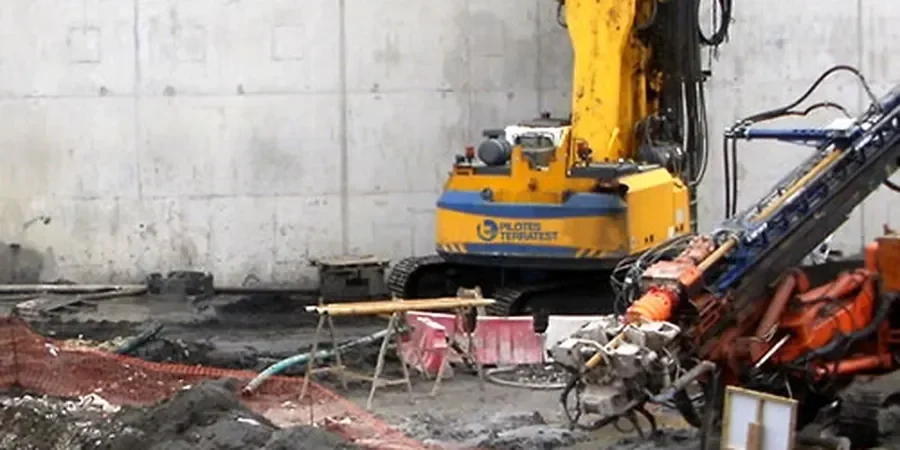
Grouting design in Derby must account for permeability contrasts between alluvial gravels and weak mudstone to avoid preferential flow and incomplete void filling.
Process overview
Local context
In the Allestree area, glacial till with high clay content contrasts sharply with the loose sandy gravels found near Derby city centre. This variation means a single injection strategy rarely works across the whole city. Grouting design in Derby must consider the risk of hydrofracture in low-strength mudstone beneath the Cathedral Quarter, while in Pride Park the risk shifts to grout washout under the high water table. Without a site-specific design, uneven Improvement can lead to differential settlement or incomplete void sealing, especially where old railway tunnels or backfilled cellars remain undocumented.
Regulatory framework
BS EN 12715:2000 – Execution of special geotechnical works – Grouting, Eurocode 7 (BS EN 1997-1:2004) – Geotechnical design, FHWA-RD-97-004 – Grouting methods for Improvement
Additional services
Permeation and Compensation Grouting
For treating alluvial sands and gravels beneath existing structures in Derby. The design specifies low-pressure injection of stable cement or chemical grouts to fill pores and lift settled slabs without disturbing the overlying building.
Void Filling and Underpinning Grout Curtains
Applied where old mine workings, abandoned cellars, or loose fills are encountered. The design includes a curtain of injection holes to create a watertight barrier and bulk filling of large cavities using controlled mortar or low-density cellular grout.
Typical parameters
Questions and answers
What are the main factors that influence grouting design in Derby?
The local geology — alluvial gravels, glacial till, and Mercia Mudstone — controls the grout type and injection pressure. Groundwater level, void geometry, and the sensitivity of adjacent structures also drive the design parameters.
How long does a typical grouting design study take?
A standard investigation and design report for a small to medium site in Derby takes 2 to 4 weeks. This includes site walkover, sampling, lab testing of grout mixes, and numerical modelling of injection patterns.
Can grouting be used to stop water ingress in Derby basements?
Yes. Permeation grouting creates a low-permeability curtain around the basement envelope. The design targets the sandy gravel layers where groundwater moves fastest, reducing inflow to acceptable levels for waterproofing standards.
What is the typical cost range for a grouting design project in Derby?
Depending on site area, depth, and complexity, the design and supervision cost typically falls between £1,030 and £3,360. Larger volumes or multiple injection phases increase the budget proportionally.