Derby grew rapidly during the Industrial Revolution, with mills and railways carved into the Derwent Valley’s steep valley sides. The city’s expansion into the surrounding hillsides means many developments now sit on or near slopes formed by glacial till and weathered mudstone. Our team has assessed these conditions for housing estates and infrastructure projects across Derby. A proper slope stability analysis is critical here, as the local geology often hides weak layers that only emerge during heavy rainfall or excavation. We combine field reconnaissance with numerical modelling to give developers confidence before they break ground. For deeper insight into the ground conditions, we often pair this work with a clasificación de suelos to understand the material behaviour at depth.
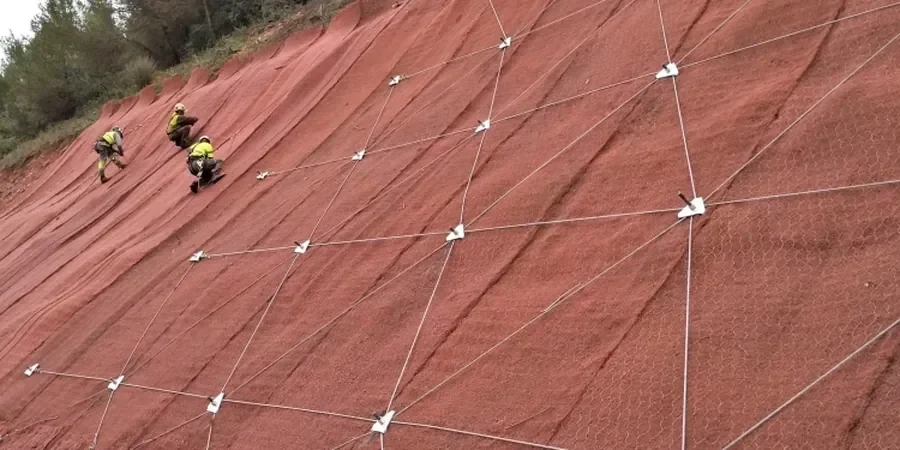
A single undetected slip surface in Derby’s glacial till can escalate into a £200k repair if caught mid-construction.
Process overview
- Desk study reviewing historical maps and mining records for Derby’s urban fringe.
- Topographical survey and kinematic analysis of joint sets in rock slopes.
- Installation of monitoring instruments with weekly readouts during construction.
Local context
Derby sits on the edge of the Pennines, where the River Derwent has cut a deep valley through Carboniferous Millstone Grit. The city’s altitude ranges from 40 m to over 120 m, and the steeper residential streets in areas like Littleover and Allestree are built on slopes that were never formally analysed. We have seen cases where garden retaining walls failed after a wet winter because the original cut was made without a stability check. Ignoring this assessment can delay construction by months and add unforeseen costs. Our slope stability analysis identifies the exact failure mechanism, whether it’s a shallow translational slide or a deep-seated rotational failure in the weathered shale.
Regulatory framework
Eurocode 7 (EN 1997-1:2004) – Geotechnical design, BS 5930:2015 – Code of practice for ground investigations, FHWA-NHI-14-007 – Rock slope stability reference manual
Additional services
Limit Equilibrium Analysis
Bishop and Spencer methods for circular and non-circular slip surfaces. Includes sensitivity analysis for varying water tables and seismic coefficients. Output includes factor of safety contours and critical slip surface geometry. Suitable for planning applications and structural design reviews.
Finite Element Modelling
2D Plaxis models with Mohr-Coulomb or Hardening Soil constitutive laws. Captures progressive failure and strain-softening behaviour. Includes coupled consolidation analysis for rapid drawdown scenarios. Delivered with contour plots of shear strain and displacement vectors.
This service complements our laboratory testing work for a complete project analysis.
Typical parameters
Questions and answers
How much does a slope stability analysis cost in Derby?
For a typical residential development slope in Derby, costs range between £900 and £3,100 depending on complexity, number of cross-sections, and whether instrumentation is required. A simple cut slope with one section may fall at the lower end, while a deep-seated failure investigation with monitoring sits at the upper end.
What triggers a slope stability assessment in Derby?
Trigger events include new construction near an existing slope, signs of cracking or bulging on a hillside, planning conditions requiring a geotechnical report, or a change in land use. Derby’s local authority often requests this for sites with a gradient steeper than 1 in 3.
How long does a slope stability study take?
A desktop assessment with limit equilibrium analysis takes one to two weeks. If field instrumentation is needed, we recommend a minimum of three months of monitoring data to capture seasonal variations. The final report is delivered within one week of completing the analysis.
Can you analyse both soil and rock slopes in Derby?
Yes, we handle both. Soil slopes in Derby typically involve glacial till and river terrace deposits. Rock slopes involve the Millstone Grit and Carboniferous shales, where we apply kinematic analysis and rockfall trajectory modelling. Each type requires different input parameters and failure criteria.