Derby's subsurface is shaped by its industrial history and proximity to the River Derwent, with significant areas of made ground from Victorian-era factories and railway embankments. These fills can be deeply heterogeneous, often containing demolition debris, coal ash, and reworked alluvium. A proper foundations on fill analysis must begin with a thorough desk study of historical maps and borehole logs to identify the extent and nature of the fill. We then combine test pitting with in-situ density testing using a sand replacement method to quantify compaction levels. Without this step, the risk of differential settlement in new structures remains unacceptably high. The River Derwent valley alone contains over 2 metres of variable fill in many post-industrial zones.
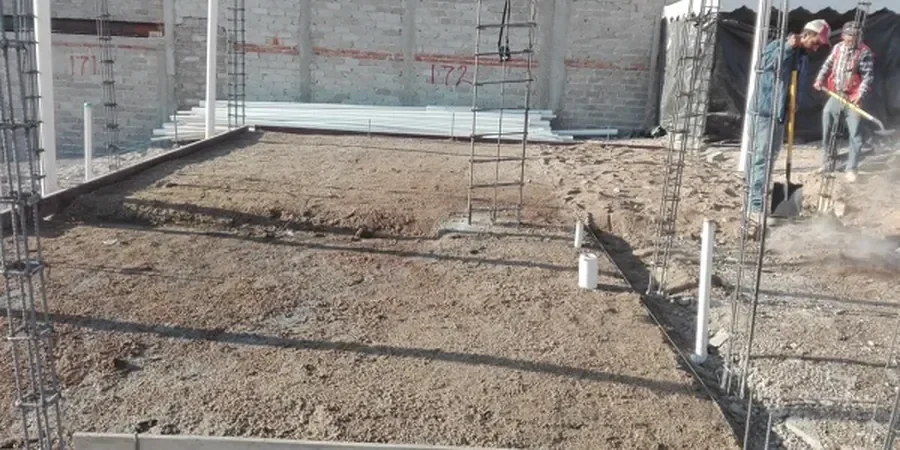
Derby's industrial fills are notoriously variable; a desk study alone cannot predict the spatial distribution of voids or compressible lenses.
Process overview
- Desk study of archival Ordnance Survey maps and mining records
- Window sampling and SPT testing to define fill stratigraphy
- Laboratory classification including Atterberg limits and sulphate content
Local context
In Derby, we frequently encounter fill that has been placed without engineered compaction, especially along the former railway sidings near the city centre. The main risk for foundations on fill in Derby is differential settlement triggered by buried voids, old cellars, or decaying timber piles from previous structures. Another common issue is sulphate attack on concrete from colliery spoil; if the analysis misses this, foundation repair costs can exceed the original construction budget. We always recommend a minimum of three trial pits per plot to capture the lateral variability. Ignoring the presence of uncompacted fill beneath a pad foundation can lead to tilting or cracking within the first two years of occupancy.
Regulatory framework
BS 5930:2015 (Code of practice for ground investigations), Eurocode 7 (EN 1997-1:2004) – Geotechnical design, CIRIA C574 (Engineering in fill materials), BS EN 1997-2:2007 (Ground investigation and testing)
Additional services
Fill Characterisation and Zonation
Detailed logging of made ground from trial pits and boreholes, including classification by origin (demolition, colliery, ash), density profiling with nuclear gauge or sand replacement, and laboratory testing for sulphate content and organic matter. The output is a fill zonation plan for your site.
Settlement and Bearing Capacity Analysis
Using SPT N-values, plate load tests, and compressibility parameters from oedometer tests to predict total and differential settlement under proposed loads. We apply both elastic and consolidation settlement models to account for the heterogeneous nature of Derby's fills.
Foundation Solution Design (Fill Sites)
We specify the most appropriate foundation type for your fill conditions, whether that involves Improvement (dynamic compaction, stone columns), deep foundations (piles to competent strata), or a reinforced raft designed to tolerate moderate differential movement. All designs comply with Eurocode 7.
Typical parameters
Questions and answers
What is the typical cost range for a foundations on fill analysis in Derby?
For a standard residential plot in Derby, expect the analysis to cost between £700 and £1.770, depending on the number of trial pits, laboratory tests required, and the complexity of the fill. Commercial or larger developments will be quoted individually based on scope.
How deep should trial pits be for fill investigation in Derby?
Trial pits should extend at least 1 metre into the natural ground beneath the fill, or to a depth of 3–4 metres below proposed foundation level, whichever is greater. In areas known for deep made ground (e.g., near the former locomotive works), pits up to 5 metres may be necessary.
Can I build directly on fill if it is well-compacted?
Yes, but only after thorough analysis. Well-compacted granular fill with a uniform density and low compressibility can support shallow foundations. However, we always verify with plate load tests and settlement monitoring. Organic or colliery fill is rarely suitable without Improvement or piling.