Derby sits at about 55 m above sea level on the River Derwent. The city's geology is dominated by alluvial deposits over Mercia Mudstone, which creates variable bearing conditions for deep foundations. Driven pile design in Derby must account for these layered profiles. We routinely see soft clays and sands near the surface, with stronger strata at depth. Our team has completed driven pile design for over forty projects in the Derby area, from industrial units to residential blocks. Before we start, we always check the historical ground conditions using borehole logs from the British Geological Survey. This helps us match the pile type to the actual soil behaviour. Combining driven pile design with a cone penetration test gives a continuous profile of tip resistance and sleeve friction, which is critical for end-bearing estimates.
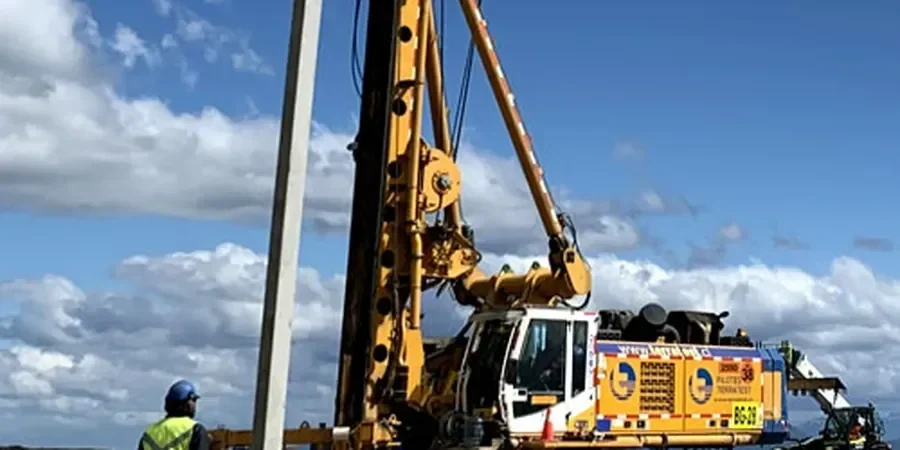
Derby's alluvial sequence over Mercia Mudstone demands site‑specific driven pile parameters, not generic design charts.
Process overview
- Ultimate shaft friction from CPT or SPT N‑values
- End‑bearing resistance based on mudstone strength
- Set‑up factor for displacement piles in clay
Local context
A recent project for a five‑storey apartment block near Derby city centre highlighted a common risk. The boreholes showed a 4 m layer of soft alluvial clay over gravel. Driven pile design initially assumed full end‑bearing in the gravel. However, a pocket of loose sand was missed in the spacing. During driving, three piles refused early. We had to re‑evaluate the shaft capacity using CPT data. That added two weeks to the schedule. The lesson is clear: without a dense grid of test points, driven pile design in Derby can underestimate variability in the alluvial cover. We now recommend CPT at every fifth pile location for urban sites.
Regulatory framework
Eurocode 7: EN 1997‑1:2004, BS EN 1997‑2:2007, BS EN ISO 22476-3‑18 (SPT)
Additional services
Borehole investigation
Rotary core and window sampling to 20 m depth. Continuous sampling in clay and sand layers. SPT at 1 m intervals. Logs include water strike and casing records.
CPT profiling
Electric cone penetration tests with pore pressure measurement. Provides continuous tip resistance, sleeve friction, and soil behaviour type. Essential for driven pile design in variable alluvium.
Laboratory testing
Triaxial compression (UU and CU), index properties, and particle size distribution. Results feed directly into shaft friction and end‑bearing calculations per EC7.
Typical parameters
Questions and answers
What is the typical cost range for a driven pile design study in Derby?
For a medium‑sized residential or commercial site, the cost typically falls between £1,120 and £2,880. The final figure depends on the number of boreholes, CPT locations, and laboratory tests required.
How deep do piles usually go in Derby's ground conditions?
Depths vary from 8 m to 18 m. Shallow piles end in the gravel layer. Deeper piles penetrate into the Mercia Mudstone for higher end‑bearing. The exact depth is determined by the CPT profile and the design load.
What is the difference between shaft friction and end‑bearing in driven pile design?
Shaft friction is the load carried by the soil along the pile shaft. End‑bearing is the load transferred at the pile tip. In Derby, shaft friction dominates in clay layers, while end‑bearing becomes significant when the pile reaches the mudstone.