I remember a project near the River Derwent where the contractor hit perched water at just 1.5 m depth — the trench caved in within minutes. That's when you realise that a proper geotechnical drainage design isn't a box-ticking exercise; it's what keeps your excavation stable and your programme on track. Derby's underlying Mercia Mudstone group and river terrace deposits create a tricky water regime, especially after wet winters. We've designed drainage blankets, trench drains and relief wells for dozens of sites across the city, from the Wyvern Business Park to housing developments in Oakwood. Before we finalise any drainage layout, we always run a permeability in the lab on undisturbed samples and cross-check with CBR values if the formation doubles as a working platform. That way the system handles both the seasonal high water table and the construction traffic without turning into a bog.
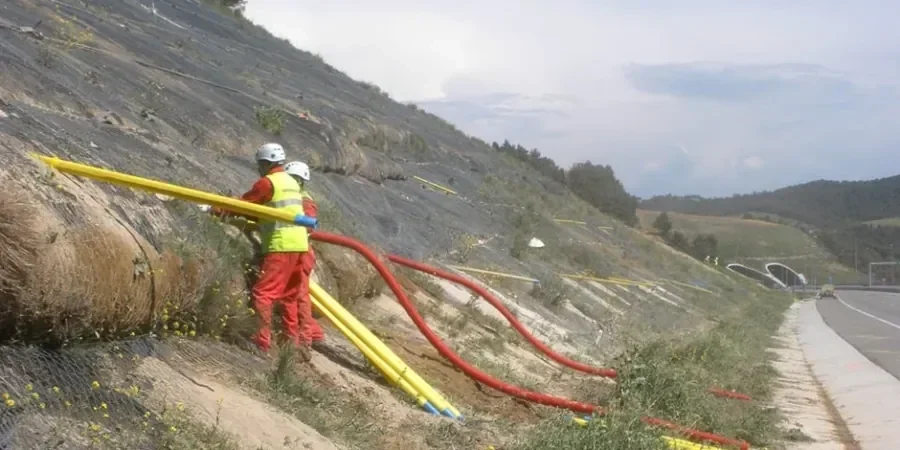
Derby's Mercia Mudstone and river terrace deposits create a tricky water regime — drainage design here must handle both seasonal high water table and construction traffic.
Process overview
Local context
We use tracked excavators with laser level control to cut the drainage trenches across Derby's sloping sites — think the hillside developments in Littleover or Mickleover. The biggest risk we see is contractors installing the drainage layer too thin because they're in a rush, or using a geotextile that doesn't meet the filtration requirements for the local silt. That leads to clogging within two winters, and then you've got water ponding against the foundation. We always supervise the placement and take in-situ density tests on the granular fill to make sure it matches the design assumptions. If the groundwater is particularly aggressive (and it can be near old industrial sites like the former railway works), we specify sulphate-resistant cement in the drainage sump and pipe surrounds.
Visual overview
Regulatory framework
BS EN 1997-1:2004 (Eurocode 7 - Geotechnical design), BS 5930:2015 (Code of practice for ground investigations), BS EN 13252:2016 (Geotextiles for drainage systems), CIRIA C750 (Groundwater control - design and practice)
Additional services
Trench & Blanket Drain Design
For shallow foundations, retaining walls and buried structures. We size the trench width, aggregate gradation and geotextile wrap based on the measured inflow rate and the site's hydraulic gradient. Output includes a drainage layout plan and a filter design note.
Relief Well & Sump Systems
When the water table is within 1.5 m of formation level — common in Derby's floodplain areas — we design vertical relief wells with submersible pumps or gravity outfall. We calculate the required number of wells, their spacing and the pump duty to keep the excavation dry during construction and the permanent works stable.
Slope & Embankment Drainage
For road cuttings, railway embankments and lagoon bunds. We design horizontal drains, toe drains and interception ditches to control pore pressures and prevent slope failures. Each design includes a stability check (Bishop's method or Spencer's method) with and without the drainage system to demonstrate the improvement in factor of safety.
Typical parameters
Questions and answers
Why is Derby's ground particularly challenging for drainage design?
Derby sits on Mercia Mudstone overlain by river terrace deposits. The mudstone is very low permeability, so water sits in the granular layers above it for weeks after rain. Combined with a high water table in the Derwent floodplain, you get perched water that can collapse trench sides and delay construction if the drainage isn't designed correctly.
How much does a geotechnical drainage design typically cost in Derby?
For a typical residential or small commercial site, the design fee ranges between £730 and £1,890 depending on the complexity of the hydrogeology and the number of drainage elements required. That includes the site visit, the seepage analysis and the final design report.
Do you need a full ground investigation before the drainage design?
Yes, ideally. We need at least two trial pits or boreholes to measure the water table, run falling-head permeability tests and classify the soil. Without that data, the drainage design is guesswork. If the site already has a ground investigation report, we can work from that as long as it includes in-situ permeability results.