Derby sits on a complex sequence of river terrace gravels, alluvium, and Mercia Mudstone that can shift unpredictably under load. Nearly 260,000 people live in this East Midlands city, and many Victorian buildings here already show signs of differential movement. For any new development or retrofit, understanding how each soil layer reacts to loading is essential. A proper differential settlement analysis identifies zones where clay shrinkage, consolidation, or lateral spreading could crack slabs or distort frames. When the ground beneath a foundation settles unevenly, even a few millimetres can misalign steel columns or shear brickwork. That is why engineers in Derby rely on site-specific data rather than textbook assumptions. Combining borehole logs with laboratory consolidation tests gives a clear picture of the risk.
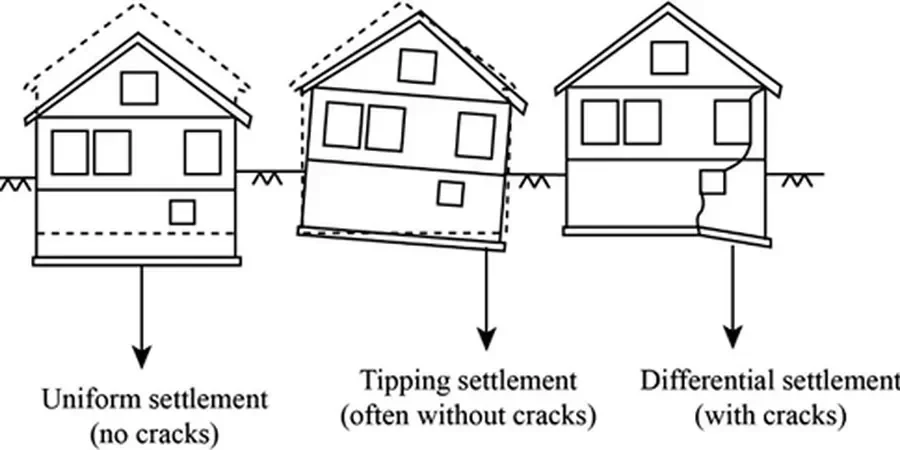
A 5 mm differential settlement can crack a reinforced concrete beam. Derby’s clay-rich subsoils demand site-specific analysis, not generic tables.
Process overview
Local context
The biggest risk in Derby is ignoring the transition zone where river terrace gravels meet glacial till. A borehole sunk 50 metres away might show competent sand, but a few metres closer to the river the same horizon turns into soft silt. This lateral variability is exactly what a differential settlement analysis catches. We deploy a 10-tonne CPT rig to get continuous profiles every 20 mm; the cone resistance plots reveal hidden lenses of soft material that could cause a slab to tilt. In one Derby retail park project, undetected peat layers under the car park caused 40 mm of differential movement within two years, cracking drainage pipes. Our analysis flags those layers early so the design team can switch to piled foundations or Improvement.
Regulatory framework
BS 5930:2015 – Code of practice for ground investigations, BS EN 1997-1:2004 – Eurocode 7: Geotechnical design, BS 1377-5 – Standard test method for one-dimensional consolidation, ISO 17025 – Laboratory accreditation for consolidation testing
Additional services
Oedometer Consolidation Testing
Multi-stage incremental loading on undisturbed samples to determine Cc, Cs, cv, and mv. Results include settlement versus time curves at each load increment.
3D Finite-Element Differential Settlement Modelling
PLAXIS 3D or GeoStudio simulations that incorporate layer geometry, groundwater, and structural stiffness. Outputs include contour maps of vertical displacement and angular distortion.
Long-Term Monitoring & Verification
Installation of settlement plates, inclinometers, and piezometers. Data-logger readings taken weekly during construction and quarterly for two years post-completion.
Typical parameters
Questions and answers
How is differential settlement analysis different from a standard soil report?
A standard soil report gives average bearing capacity and basic soil classification. Differential settlement analysis focuses on relative movement between foundation elements. It uses consolidation tests, creep parameters, and 3D modelling to predict how much one column will settle more than another.
Why is differential settlement a particular concern in Derby?
Derby’s subsoil is highly variable due to river terrace deposits over Mercia Mudstone. You can have stiff clay under one footing and soft silt under the next. The city also has a high water table that fluctuates seasonally, accelerating consolidation in compressible layers.
What methods do you use to measure consolidation parameters?
We run oedometer tests per BS 1377-5 on undisturbed thin-walled samples. For sensitive clays we use Rowe cell consolidation to apply back-pressure and measure pore pressure dissipation. All tests are performed in our UKAS-accredited soil mechanics laboratory.
Can you retrofit differential settlement analysis to an existing building in Derby?
Yes. For existing structures we install precise levelling points on the ground floor slab and columns, take baseline readings, and compare them with historical crack surveys. We then correlate the measured movement with ground investigation data to determine the cause and recommend remedial Improvement.
How much does a typical differential settlement analysis cost in Derby?
The cost ranges from £610 to £1,530 depending on the number of boreholes, laboratory tests, and complexity of the 3D model. A basic analysis for a small extension with 2 boreholes and 4 oedometer tests is at the lower end; a full commercial development with 8+ boreholes and advanced modelling sits at the upper end.