The difference between designing an MSE wall in central Derby near the River Derwent floodplain versus the stiffer clay terraces found in suburban Allestree is substantial, and ignoring it leads to long-term deformation. Mechanically stabilized earth wall design relies on the frictional interaction between granular backfill and tensile reinforcements — but the local groundwater regime and clay plasticity index shift the required reinforcement length and spacing considerably. Before specifying geogrid or strip reinforcements, a thorough assessment of the existing soil profile is essential; we often complement this work with a clasificación de suelos to confirm the backfill material meets grading requirements and with ensayos de corte directo on the foundation layer to obtain realistic interface shear angles for the design calculations.
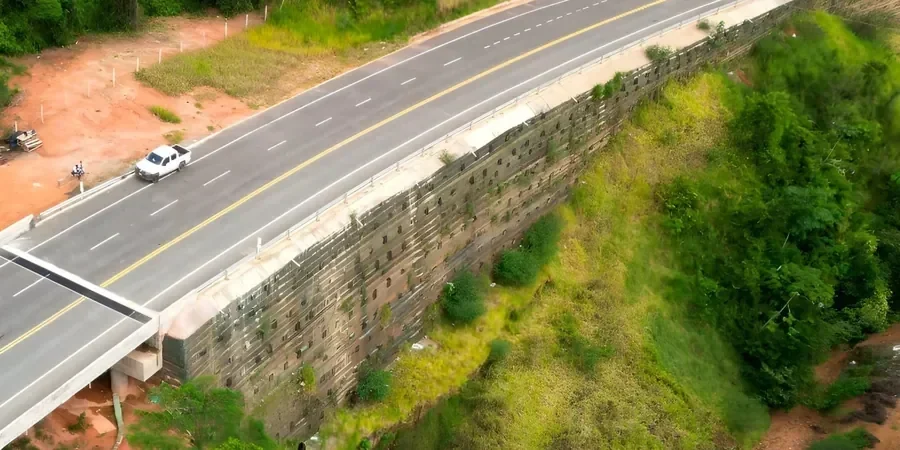
Correct MSE wall design in Derby requires site-specific shear strength parameters from the Keuper Marl, not generic book values.
Process overview
Local context
Eurocode 7 (BS EN 1997-1:2004) and the UK National Annex mandate that MSE wall design in Derby must consider both ultimate and serviceability limit states, with specific partial factors applied to the reinforcement tensile strength and the soil shear strength. The risk is elevated here because the local clay formations can undergo significant volumetric changes with seasonal moisture fluctuations, and the river terrace deposits in low-lying areas of the city may have loose zones that reduce passive resistance at the toe. A design that omits a sensitivity analysis for groundwater level variation can track record face bulging or differential settlement within the first five years.
Regulatory framework
BS EN 1997-1:2004 (Eurocode 7 – Geotechnical design), BS EN 1990:2002 + A1:2005 (Basis of structural design), BS EN 13242:2002 (Aggregates for unbound and hydraulically bound materials), BS 8006-1:2010 (Code of practice for strengthened/reinforced soils)
Additional services
Preliminary wall geometry and stability assessment
We define the wall alignment, maximum height, and tiered configuration based on site topography, right-of-way constraints, and foundation conditions. An initial limit-equilibrium check identifies whether a single-tier or multi-tier solution is optimal.
Reinforcement selection and pullout verification
Based on the design tensile load at each layer, we select geogrid or steel strip reinforcement and verify the anchorage length against pullout using the measured interface friction angle from direct shear tests on the actual fill material.
Drainage and facing panel design
We specify the internal drainage system (chimney drains, blanket drains) to prevent hydrostatic pressure buildup, and design the precast concrete facing panels with connection details that accommodate differential movement without cracking.
Typical parameters
Questions and answers
What is the typical cost range for MSE wall design in Derby?
For a complete design package including stability calculations, reinforcement schedule, and construction drawings, the fee typically ranges from £940 to £3,160 depending on wall height, number of tiers, and site complexity. This excludes material supply and installation.
How long does the MSE wall design process take?
A single-tier wall up to 6 m high can be designed within 3 to 4 weeks once the geotechnical parameters are confirmed. Multi-tier or complex geometry walls may require 6 to 8 weeks due to the additional stability checks and reinforcement optimisation.
What soil parameters are required for MSE wall design in Derby?
We need the foundation soil's undrained shear strength (cu), effective friction angle (phi'), unit weight, and groundwater level. For the reinforced fill we require the particle size distribution and the interface friction angle with the chosen reinforcement, determined by direct shear testing on the actual fill.
Can MSE walls be built on soft clay in Derby?
Yes, but the foundation must be improved or the wall geometry adjusted. Options include lightweight fill to reduce vertical stress, stone columns to accelerate consolidation, or a wider base to spread the load. We include a bearing capacity check and settlement analysis in every design.