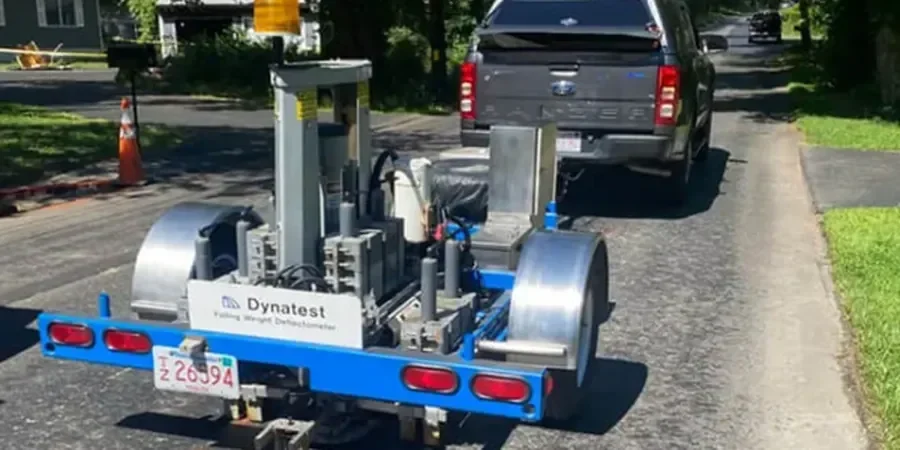
In Derby, many industrial and residential roads show distress from decades of traffic and variable clay subgrades. An existing pavement evaluation identifies the root cause of cracking, rutting, or drainage failure before you commit to repairs. We combine FWD deflections, coring, and dynamic cone penetrometer testing to map structural capacity across the pavement section. For projects requiring deeper insight into foundation layers, we often pair this with a georradar survey to detect voids or utility conflicts without excavation. This integrated approach saves time and avoids guesswork.
A full existing pavement evaluation in Derby typically costs between £1,110 and £3,070, depending on site extent and testing complexity.
Process overview
Local context
Derby expanded rapidly during the industrial revolution, with many roads built directly on soft ground or old mine workings. Without a proper existing pavement evaluation, you risk overlaying a failed subgrade that will propagate cracks through new asphalt within 12 months. The biggest hazard is ignoring moisture-sensitive clay layers beneath the base course. Seasonal swelling and shrinkage can heave pavements unevenly, leading to premature failure. A thorough investigation identifies these risk zones before money is spent on surface treatments.
Regulatory framework
BS 1377-4:1990 (CBR in laboratory), BS 1377 (FWD deflection), TRL Report 712 (pavement design), Eurocode 7 (EN 1997-1:2004)
Additional services
FWD Deflection Testing
Non-destructive deflection basin measurement at 10 m intervals to calculate structural number and remaining life.
Coring and Layer Profiling
100 mm diameter cores extracted to measure thickness, material type, and bonding condition of each pavement layer.
DCP and CBR Correlation
Dynamic cone penetrometer readings correlated to CBR values for rapid subgrade strength profiling.
Laboratory Material Classification
Sieve analysis, Atterberg limits, and soaked CBR tests on pavement materials to BS 1377 standards.
Typical parameters
Questions and answers
What is an existing pavement evaluation?
It is a systematic investigation of an existing road or pavement structure to determine its structural capacity, remaining life, and the causes of distress such as cracking or rutting.
How much does an existing pavement evaluation cost in Derby?
The typical cost ranges from £1,110 to £3,070 depending on site area, number of test locations, and the complexity of laboratory testing required.
Which tests are performed during a pavement evaluation?
Common tests include falling weight deflectometer (FWD) testing, dynamic cone penetrometer (DCP) profiling, coring for layer thickness, and laboratory CBR and classification tests.
How long does a pavement evaluation take?
A typical evaluation for a 500 m road section takes 2 to 4 days in the field, plus 5 to 10 working days for laboratory testing and reporting.
Do I need planning permission for a pavement investigation?
No planning permission is required for non-invasive tests like FWD and DCP. Coring and trial pits may require a Section 50 permit from the local highway authority for public roads.