The clay-rich soils under the A52 near Spondon behave very differently from the sandy gravels found beneath the Pride Park business district. This contrast matters when planning road upgrades or new access routes. In Derby, where glacial till and alluvial deposits alternate unpredictably, soil stabilization for roads must address both low bearing capacity and high plasticity. Our approach combines laboratory classification with field verification, ensuring that the selected treatment — whether lime, cement, or granular replacement — matches the exact ground conditions. For pavements in the city centre, the presence of old fill from Victorian era construction adds another layer of complexity, requiring a careful ensayo CBR assessment before any stabilization design is finalised.
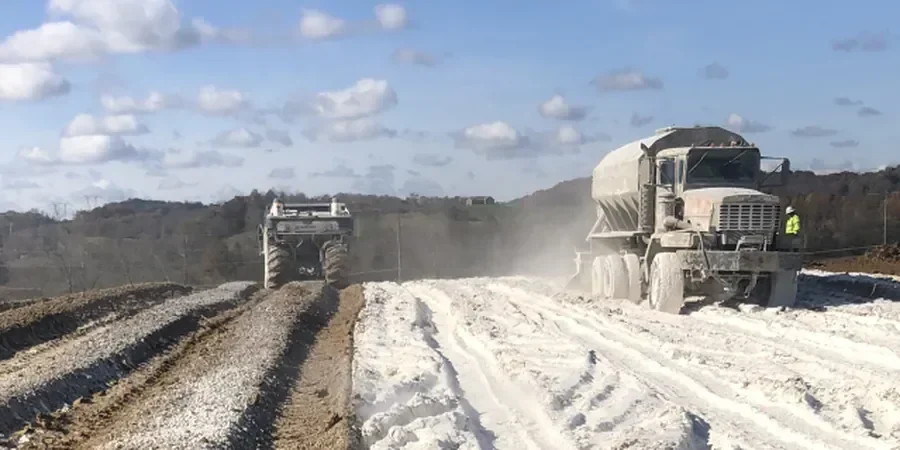
In Derby, where glacial till and alluvial deposits alternate, soil stabilization for roads must match both bearing capacity and plasticity conditions precisely.
Process overview
Local context
A track-mounted stabilizer and a pneumatic lime spreader are the key machines on a Derby road site. The operator must coordinate the spread rate with the rotor depth — typically 250 to 400 mm — to avoid over-treatment or patchy mixing. In confined urban streets around the Cathedral Quarter, access for bulk tankers can be tight, so we plan logistics to minimise disruption. The biggest risk is insufficient curing time before trafficking: if a treated layer is opened to site lorries before reaching 80% of its design strength, cracking and loss of modulus can occur. We enforce a minimum 7-day curing period with daily moisture checks, especially when working in Derby's clay soils that retain water longer than sandy fills.
Regulatory framework
BS EN 1997-2:2007 (Eurocode 7 – Ground investigation and testing), BS 1377-4:1990 (Methods of test for soils – Compaction-related tests), BS EN 13286-40:2003 (Unbound and hydraulically bound mixtures – Test method for the determination of the direct tensile strength), BS 6031:2009 (Code of practice for earthworks)
Additional services
Lime Stabilisation for Clay Subgrades
Treatment of high-plasticity clays with quicklime or hydrated lime to reduce plasticity, increase workability, and achieve a design CBR of 15% or more. Suitable for residential roads and industrial access routes in Derby.
Cement Bound Granular Mixtures (CBGM)
Blending Portland cement with granular materials to produce a stiff, low-shrinkage base layer for heavy-duty pavements. We control the cement content to between 3% and 6% to avoid reflective cracking.
Subgrade Improvement with Geosynthetics
Where chemical treatment is not viable, we install geogrids or woven geotextiles combined with granular capping layers. This method is effective on soft alluvial deposits near the River Derwent.
This service complements our laboratory testing work for a complete project analysis.
Typical parameters
Questions and answers
What is the typical cost range for soil stabilization for roads in Derby?
For a standard road project in Derby, the cost typically falls between £590 and £2,320 per project, depending on the area treated, depth of stabilisation, and whether lime or cement is used. A detailed site assessment is needed to deliver an accurate quote.
How long does a full stabilization treatment take for a typical Derby road section?
A treatment cycle — from spreading and mixing to compaction and curing — usually takes 10 to 14 days for a 200-metre road section. The curing period alone requires at least 7 days before the layer can be trafficked, longer if wet weather delays drying.
Can soil stabilization be applied to Derby's historic fill or made ground?
Yes, but it requires careful characterisation first. Old fill often contains brick fragments, ash, and organic matter, which can interfere with chemical reactions. We always perform a full classification including Atterberg limits and organic content before recommending treatment.
What testing is required before and after stabilization in Derby?
Before treatment, we run classification tests (grading, plasticity, natural moisture content) and a Modified Proctor to set target density. After mixing, we take in-situ density cores and perform CBR tests at 7 and 28 days to verify that the design strength has been achieved.