Derby grew fast during the Industrial Revolution, with factories and railways spreading over the Trent Valley floodplain. That history means the ground here is layered – alluvial clays, river terrace gravels, and glacial till from the last ice age. We see it every time we drill. A proper soil mechanics study in Derby has to account for those mixed deposits, especially where old mill foundations or made ground sit under modern developments. Before we start fieldwork we always review historical maps of the site. That step alone can save weeks of rework. Combining that with an ensayo SPT gives us the first read on strength and stratification.
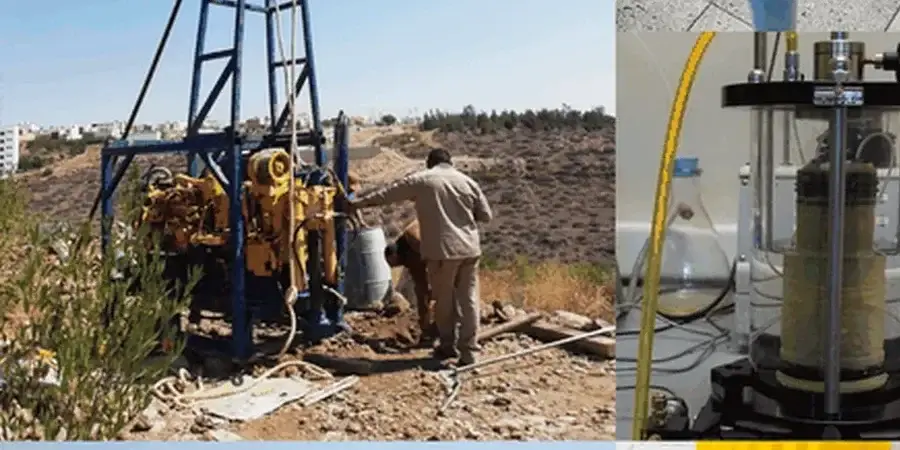
Derby’s mixed alluvial and glacial soils demand site-specific testing – a single borehole rarely tells the full story beneath the Trent floodplain.
Process overview
Local context
The biggest geotechnical risk in Derby comes from the variable depth and consistency of glacial till overlying the Triassic bedrock. In some areas the till is a stiff clay with high bearing capacity; in others it thins to less than a metre above weathered mudstone. That variability can cause differential settlement if foundations are designed on average values alone. On top of that, the water table in the Trent Valley fluctuates seasonally by up to 2.5 metres. A soil mechanics study in Derby must include groundwater monitoring over at least one wet season to avoid underestimating pore pressures during excavation or basement construction.
Regulatory framework
BS 5930:2015 – Code of practice for site investigations, Eurocode 7 (BS EN 1997-1:2004) – Geotechnical design, BS EN ISO 22476-3 – Standard test for SPT, BS 1377:1990 – Methods of test for soils for civil engineering purposes
Additional services
Site Investigation & Sampling
We drill boreholes, excavate test pits, and extract undisturbed tube samples using thin-walled Shelby tubes. All sampling follows BS 5930 and Eurocode 7 procedures. The team logs strata in real time and seals samples for transport to our UKAS-accredited lab in the East Midlands.
Laboratory Testing Suite
We run classification tests (moisture content, Atterberg limits, particle size distribution) and mechanical tests (triaxial CU and UU, direct shear, one-dimensional oedometer). Each soil mechanics study in Derby includes a summary report with interpreted parameters for foundation design and slope stability analysis.
Typical parameters
Questions and answers
What does a soil mechanics study in Derby typically cost?
For a standard residential or small commercial site in Derby, the cost ranges between £2.820 and £4.760 depending on borehole depth, number of samples, and the laboratory tests required. We deliver a fixed-price quotation after reviewing the site location and ground conditions.
How deep do boreholes need to be for a Derby site?
Depth depends on the foundation type and the local geology. For strip footings on glacial till, we usually drill to 6-8 metres. For piled foundations bearing on Sherwood Sandstone, boreholes often go to 12-15 metres. The soil mechanics study in Derby includes a desk study to estimate the required depth before mobilisation.
Do you provide UKAS-accredited laboratory results?
Yes. Our lab holds UKAS accreditation (ISO 17025) for all common geotechnical tests. Every soil mechanics study in Derby is issued with a signed certificate and a full test schedule. The report includes the raw data, the interpretation, and the relevant British Standard references.