Ground improvement in Derby represents a critical discipline within geotechnical engineering, encompassing a suite of techniques designed to enhance the engineering properties of soils and rocks to safely support construction. The city's industrial heritage, coupled with ongoing urban regeneration, means that developers frequently encounter challenging ground conditions ranging from soft alluvial deposits to variable made ground. Without targeted intervention, these soils can exhibit inadequate bearing capacity, excessive settlement, or instability under load. The category covers everything from densification and drainage to reinforcement and chemical stabilisation, ensuring that even the most marginal sites can be transformed into viable building platforms for residential, commercial, and infrastructure projects.
Derby's geological setting is dominated by the River Derwent and its tributaries, which have deposited layers of soft silts, clays, and sands across the valley floor. These recent alluvial soils often overlie Mercia Mudstone bedrock, creating a two-layer system where weak near-surface materials mask competent strata below. In other areas, particularly towards the city's historic core, extensive made ground composed of ash, brick rubble, and industrial by-products can extend several metres deep. Such conditions demand rigorous site investigation and a nuanced understanding of local ground behaviour, as standard foundation solutions may prove insufficient. The presence of shallow groundwater tables further complicates construction, making dewatering and drainage integral to many improvement strategies.
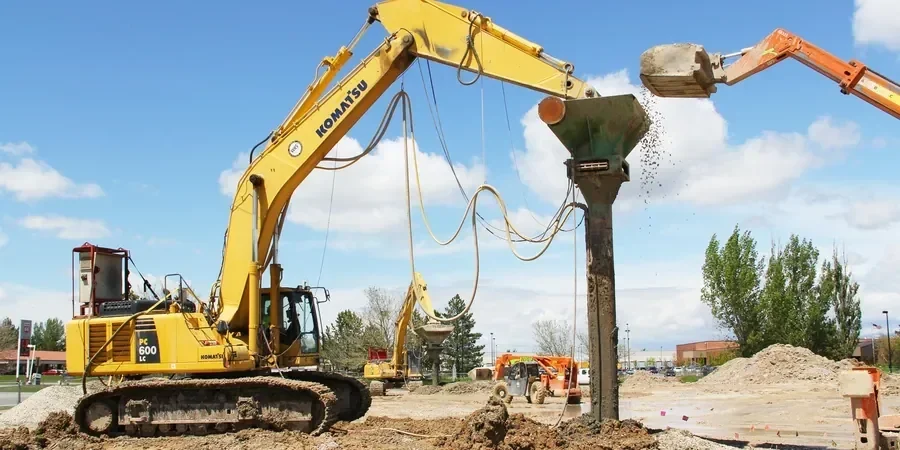
All ground improvement works in the United Kingdom must comply with the relevant parts of Eurocode 7 (BS EN 1997), which governs geotechnical design, and the associated UK National Annexes. Execution is typically guided by the Institution of Civil Engineers' Specification for Ground Treatment, ensuring that methods such as vibrocompaction design and stone column design meet rigorous performance standards. Environmental permitting and waste management regulations, particularly where grouting is involved, are overseen by the Environment Agency. For projects in Derby, planning authorities will also expect a robust geotechnical design report that demonstrates how the chosen improvement technique mitigates identified risks in line with CDM 2015 regulations, ensuring safety throughout the construction lifecycle.
The types of projects driving demand for ground improvement in Derby are diverse. The ongoing transformation of brownfield sites for housing and mixed-use developments frequently necessitates dynamic compaction design to densify loose fills and control differential settlement. Infrastructure schemes, such as flood defence works along the Derwent, rely on geotechnical drainage design to manage pore water pressures and maintain soil stability. Industrial facilities and warehouse complexes, common in the city's commercial zones, often require stone columns or vibrocompaction to support heavily loaded floor slabs. Even smaller-scale residential extensions can benefit from targeted improvement when encountering unexpected soft spots, underscoring the broad applicability of these techniques.
Available services
Unsaturated soil analysis
→ Ver detalleStone column design
→ Ver detalleDynamic compaction design
→ Ver detalleGeotechnical drainage design
→ Ver detalleGrouting design
→ Ver detalleJet grouting design
→ Ver detallePreloading with surcharge design
→ Ver detalleVibrocompaction design
→ Ver detalleGeomembrane specification
→ Ver detalleLime and cement stabilization
→ Ver detalleLandfill geotechnics
→ Ver detalleOrganic soil management
→ Ver detalleContaminated soil remediation
→ Ver detalleQuestions and answers
What is ground improvement and when is it necessary?
Ground improvement refers to a range of geotechnical techniques used to permanently enhance the physical properties of soil or rock, such as strength, stiffness, and permeability. It becomes necessary when site investigation reveals that the natural ground cannot adequately support proposed loads without excessive settlement or risk of failure. This is common in areas with soft clays, loose sands, or man-made fill, where traditional shallow foundations would require over-excavation or piling.
How do I know which ground improvement technique is right for my site in Derby?
Selecting the appropriate technique requires a thorough geotechnical site investigation to define soil stratigraphy, strength parameters, and groundwater conditions. The choice depends on soil type, depth of improvement required, loading conditions, and environmental constraints. For example, loose granular soils may respond well to vibrocompaction, whereas soft cohesive soils might require stone columns or preloading. A specialist geotechnical engineer will interpret this data to recommend a cost-effective and technically suitable solution tailored to Derby's local ground conditions.
What are the key regulatory standards governing ground improvement in the UK?
Ground improvement in the UK is primarily governed by Eurocode 7 (BS EN 1997) and its National Annex, which set out principles for geotechnical design and limit states. Execution is typically specified according to the Institution of Civil Engineers' Specification for Ground Treatment. Environmental controls, particularly for grouting techniques, are regulated by the Environment Agency. Additionally, all construction activities must comply with CDM 2015 regulations, placing duties on designers and contractors to manage health and safety risks throughout the project.
Can ground improvement be used as an alternative to deep piling?
Yes, ground improvement is often a cost-effective and technically viable alternative to deep piling, particularly where treatment can create a competent block of improved ground suitable for shallow foundations. Techniques like stone columns and vibrocompaction can deliver the necessary bearing capacity and settlement control to eliminate the need for deep piles. This approach can offer significant advantages in terms of programme speed and reduced spoil disposal, but its suitability depends entirely on the specific soil profile and project requirements.