Derby sits on a varied geology where river terrace gravels and Mercia Mudstone dominate the shallow subsurface. These materials behave very differently under repeated traffic loads. A CBR study for road design in Derby must account for the high plasticity clays found along the Derwent valley, which lose strength rapidly when wet. We apply the soaked CBR test method per BS 1377-4 to simulate worst-case moisture conditions before placing pavement layers. This data directly informs the design of flexible and rigid pavements, helping engineers avoid premature rutting or shear failure.
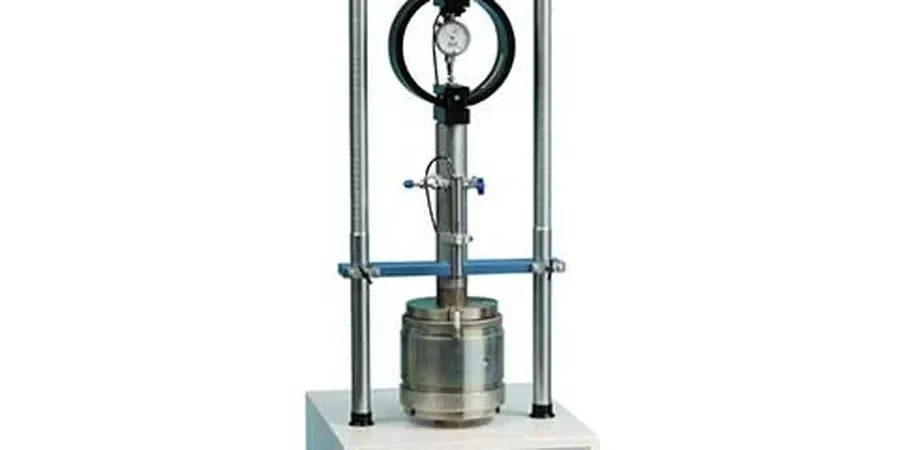
A soaked CBR below 2% in Mercia Mudstone means the subgrade requires stabilisation before any pavement layer is placed.
Process overview
- Penetration test at 1.27 mm/min using a standard plunger (49.6 mm diameter)
- Load vs penetration curve recorded up to 7.5 mm
- Correction for surface irregularities per BS 1377-4
Local context
A common mistake in Derby is assuming the topsoil CBR value remains constant after excavation. Contractors who skip a CBR study for road design in Derby often design pavements based on dry-season tests, ignoring the swell potential of underlying clays. When winter comes, the subgrade loses strength, the pavement cracks at the edges, and the road fails within two years. We have seen this repeatedly on industrial access roads near the A50. A proper soaked CBR test catches this risk before the asphalt goes down.
Regulatory framework
BS 1377-4:1990 – Methods of test for soils for civil engineering purposes (Compaction and CBR), BS 1377-2:1990 – Classification tests (plasticity, particle size), Eurocode 7 (BS EN 1997-2:2007) – Ground investigation and testing
Additional services
Laboratory CBR on Block Samples
We collect undisturbed block samples from trial pits or test trenches, seal them in wax, and transport them to our lab. The sample is soaked for 96 hours and tested at natural moisture content. This gives a direct measure of in-situ subgrade strength for pavement design.
In-Situ CBR with Dynamic Cone Penetrometer (DCP)
For fast, low-cost profiling of existing subgrades and compaction layers, we use the DCP to derive CBR values at 100 mm intervals. This is ideal for verifying layer uniformity along long road alignments in Derby, especially during earthworks control.
Typical parameters
Questions and answers
What is the typical CBR value for clay subgrades in Derby?
Mercia Mudstone clay in Derby usually gives soaked CBR values between 1.5% and 3.5%. River terrace gravels can reach 15% to 25% when compacted. Values below 2% require stabilisation with lime or cement before pavement construction.
How long does the CBR study for road design take?
A standard laboratory soaked CBR test takes 5 working days from sample reception: 4 days for soaking and 1 day for penetration testing. In-situ DCP profiling can be completed on site in a single day, with results reported within 48 hours.
What is the cost range for a CBR study in Derby?
The cost for a laboratory CBR test (including block sampling and soaked test) ranges between £110 and £240 per sample. In-situ DCP profiling is typically £130 - £200 per test point. Volume discounts apply for multiple locations along a single road project.
Do you test at the natural moisture content or at a soaked condition?
We test both. The soaked CBR (96-hour water immersion) simulates worst-case winter conditions, which is mandatory for pavement design in Derby. The unsoaked CBR at natural moisture content provides a reference for construction-stage control and compaction verification.