Derby expanded rapidly during the Industrial Revolution, with heavy rail and engineering works built over alluvial river terraces and glacial till. Much of the city centre sits on firm to stiff clays over Mercia Mudstone, but along the Derwent valley you find soft alluvium and made ground from old mill foundations. The SPT (Standard Penetration Test) has been the backbone of British site investigation since the 1950s. We drive a split-barrel sampler using a 63.5 kg hammer falling 760 mm, recording blows per 300 mm penetration. For Derby’s mixed geology, this gives us reliable N-values for both cimentaciones superficiales and deep foundation design.
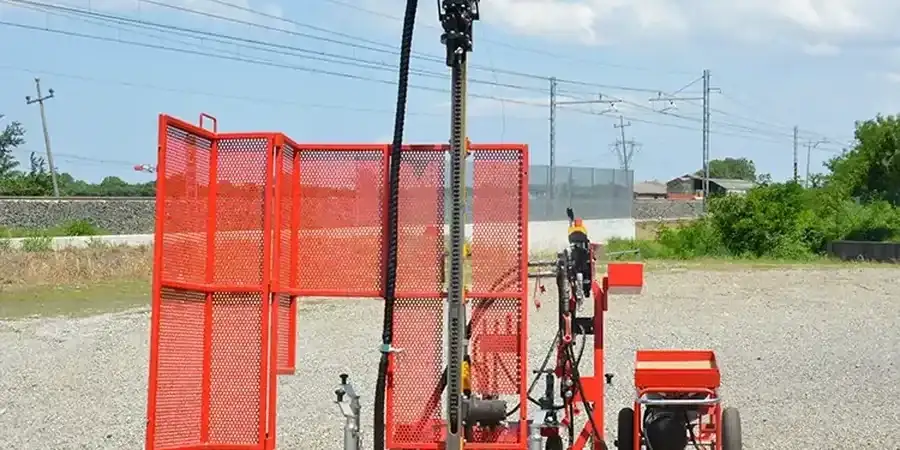
In Derby’s glacial till, SPT N-values can double within 2 m – one missed test and your bearing capacity estimate is wrong.
Process overview
Local context
In Derby, we often see borehole logs from the 1970s that stopped at refusal in the made ground. That is dangerous. The old industrial fill around the railway works contains cobbles and old brick – it can give false high N-values. If you stop there, you miss the underlying soft alluvium that causes differential settlement. We always drill through the fill into natural strata. Another local risk: the Mercia Mudstone weathers rapidly once exposed. SPT in the weathered zone can underestimate strength unless the test is done immediately after boring. Our crews are trained to test within minutes of reaching each depth.
Regulatory framework
BS EN 1997-2:2007 (Eurocode 7 – Ground investigation), BS 5930:2015 (Code of practice for ground investigations), BS EN ISO 22476-3 (Standard Test Method for SPT)
Additional services
Continuous SPT Profiling for Deep Foundations
Tests at 1.0 m intervals to depths of 30 m using a tracked rig. Suitable for piled foundations in Derby’s clay and sandstone. Includes energy measurement and N-value corrections to 60 % standard.
Shallow SPT for Residential & Pavement Design
Refusal-driven tests to 6 m depth. Used for strip footings and road subgrade assessment. Delivered with real-time logging and a summary report within 48 hours.
Typical parameters
Questions and answers
How much does an SPT investigation in Derby cost?
For a standard borehole with SPT at 1 m intervals to 15 m depth, expect £440 – £550 per borehole, including mobilisation within Derby city limits. Volume discounts apply for multiple holes.
What is the difference between N-SPT and undrained shear strength in Derby clays?
For Derby's stiff clays, we use the correlation cᵤ ≈ 5 × N (kPa) from BS 5930. In glacial till the factor can drop to 3–4. We always validate with a triaxial test on undisturbed samples from the same stratum.
Can SPT detect old mine workings or cavities under Derby?
SPT alone cannot detect voids. A sudden drop in N-value (e.g. from refusal to N=2) may indicate a cavity, but we recommend combining SPT with georradar-gpr for void detection in areas like Darley Abbey or Chaddesden where shallow coal workings are recorded.