Derby sits on a mix of river terrace deposits and glacial till from the Derwent valley, which means subgrade conditions can shift drastically within a single site. Heavy winter rainfall keeps moisture content high, and that directly affects California Bearing Ratio values. A laboratory CBR test gives you a controlled measurement of the soaked strength, not just a field guess. We compact samples at Proctor optimum moisture, soak them for four days, and then penetrate at 1.27 mm/min per BS 1377-4. That data feeds directly into pavement thickness design and helps avoid premature cracking or rutting on Derby roads and industrial yards. Before testing, a subgrade classification via Atterberg limits tells us how the soil will behave under load.
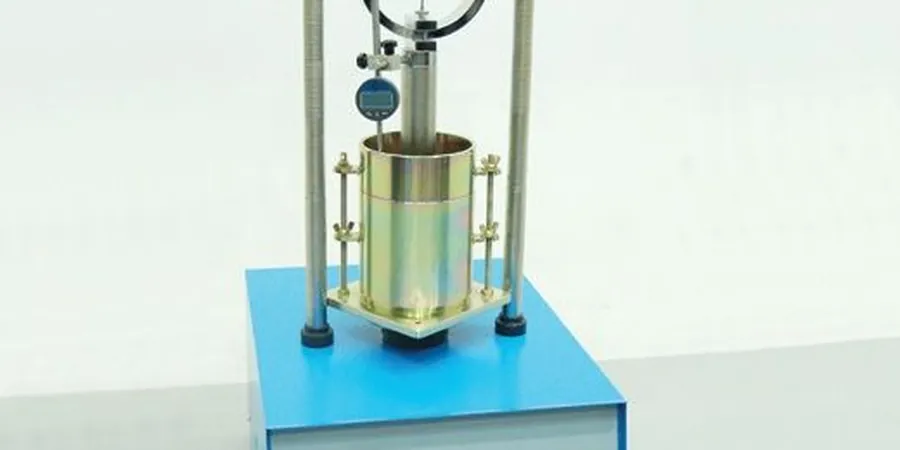
Soaking a CBR sample for 96 hours reveals how the subgrade performs after heavy winter rain, a critical factor for Derby pavements.
Process overview
Local context
In Derby we often see foundation teams skip the lab CBR and rely only on a field DCP. That works for a rough check, but the soaked lab value tells you what happens after a wet winter. The city's clay tills lose up to 60% of their strength when saturated. If you design pavement thickness on dry CBR alone, you risk cracking within two years. The lab test costs a fraction of a failed road repair. Combine it with a plate load test for verification on site.
Regulatory framework
BS 1377-4:1990 – Methods of test for soils for civil engineering purposes, BS EN 13286-47:2004 – Unbound and hydraulically bound mixtures, UKAS ISO 17025 accreditation for laboratory testing
Additional services
Standard Soaked CBR Test
Sample compacted at Proctor optimum, soaked 96 hours, then penetrated. Includes load-penetration curve and CBR at 2.5 mm and 5.0 mm. Suitable for residential roads and light industrial pavements.
Modified Proctor CBR Test
Higher compactive effort for heavy-load pavements. Sample compacted at modified Proctor energy, then soaked and tested. Used for HGV routes and warehouse yards in Derby.
Unsoaked CBR Test
Quick turnaround test without soaking. Provides a baseline for dry-season conditions or when moisture control is guaranteed on site. Results in 24 hours from sample receipt.
Typical parameters
Questions and answers
How long does a laboratory CBR test take in Derby?
The standard soaked CBR test takes 5 to 7 working days. The 96-hour soak is the fixed delay. We can deliver unsoaked results within 24 hours if you need a fast baseline.
What is the cost range for a laboratory CBR test?
A single soaked CBR test typically costs between £100 and £160 per sample, depending on the compaction energy and whether you need a full load-penetration curve. Volume discounts apply for multiple samples from the same site.
Do you accept samples delivered to the lab, or do you collect?
Both. You can deliver bulk disturbed samples to our Derby lab. We also offer site collection for a small fee. Samples must be in sealed bags to retain moisture content.
What is the difference between field DCP and laboratory CBR?
A field DCP gives a quick in-situ estimate. The laboratory CBR test is a controlled, repeatable measurement on a compacted sample at specific density and moisture. Only the lab test accounts for soaking, which simulates worst-case winter saturation.