A few years back we were called to a site off the A52 near the Brian Clough Way where a new distributor road was planned. The ground looked like stiff clay at surface, but once we dug in we found a mixed sequence of glacial till and river terrace deposits that changed strength every few metres. That project taught us something we apply to every road geotechnics assignment in Derby: you cannot guess the subgrade from surface appearance. We ran CBR tests, Atterberg limits, and compaction trials to get a reliable design modulus. Before any pavement design we recommend a CBR vial assessment to establish the bearing capacity of the natural ground, because the difference between a CBR of 2% and 5% can alter the pavement thickness by over 150 mm. That kind of saving matters when you are building kilometres of road.
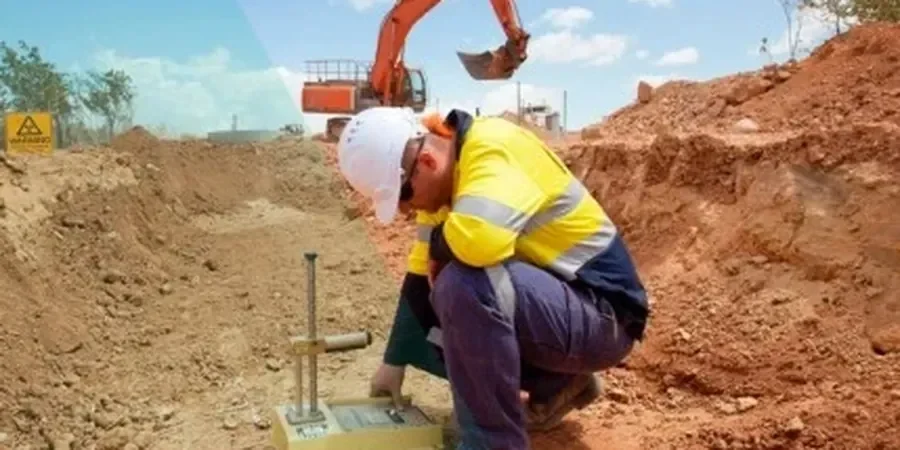
A CBR of 2% versus 5% can alter pavement thickness by over 150 mm. Those savings matter.
Process overview
Local context
Derby sits at about 50 metres above sea level, but the risk is not altitude — it is the presence of soft alluvial clays along the Derwent corridor. In the 2019 floods, several roads in the Pride Park area suffered subgrade saturation that reduced bearing capacity by over 60% within 48 hours. For road geotechnics in Derby, we model worst-case moisture scenarios using the soaked CBR test, and we design drainage layers that can handle a 1-in-100-year event. If the subgrade is prone to softening, we specify a capping layer of granular material or treat the soil with lime. We have seen roads built on untreated clay fail within three winters, so the extra investment in subgrade preparation pays for itself many times over in reduced maintenance.
Regulatory framework
BS 1377:1990 (Methods of test for soils for civil engineering purposes), BS EN 1997-2:2007 (Eurocode 7 – Ground investigation and testing), Design Manual for Roads and Bridges (DMRB) CD 225
Additional services
Subgrade Investigation and CBR Testing
In-situ CBR tests using the DCP and plate load methods, plus laboratory soaked CBR on remoulded samples. We classify the soil to BS 5930 and deliver design CBR values for each pavement layer. This service covers the full spectrum from minor access roads to heavy haul routes.
Pavement Design Support and Material Optimisation
We analyse the subgrade stiffness, traffic loading, and environmental conditions to recommend pavement thickness and layer composition. Using the DMRB method, we assess whether recycled asphalt or locally sourced aggregates can replace imported granular material, reducing cost and embodied carbon.
Typical parameters
Questions and answers
What is the typical CBR range for subgrade soils in Derby?
In Derby, the natural subgrade (glacial till and river terrace deposits) typically gives soaked CBR values between 2% and 12%. The lower end is common in soft alluvial clays near the Derwent, while the higher values come from dense gravelly till. We always recommend site-specific testing because the variability can be high within a single site.
How do you test the subgrade for a road project in Derby?
We start with trial pits to log the soil profile, then take undisturbed and remoulded samples for laboratory testing. The key tests are soaked CBR (BS 1377:1990), Atterberg limits, particle size distribution, and compaction characteristics. On site we use the dynamic cone penetrometer (DCP) to get a profile of in-situ strength, and we correlate that with lab CBR results.
What is the difference between soaked and unsoaked CBR for pavement design?
The soaked CBR test simulates worst-case moisture conditions after four days of water immersion. For road design in Derby, where the water table can rise after heavy rain, we always use the soaked value for the subgrade layer. The unsoaked CBR is useful for assessing the material at its natural moisture content, typically for capping or fill layers above the water table.
Do you provide pavement thickness design as part of the geotechnical investigation?
Yes, we do. After we determine the design CBR and subgrade modulus, we apply the DMRB CD 225 method to calculate the required pavement thickness for the expected traffic loading. We also advise on the need for a capping layer or subgrade improvement if the CBR is below 3%. The output is a practical thickness design with material specifications.
How much does a road geotechnics investigation cost in Derby?
For a typical road project in Derby, the cost for a subgrade investigation with CBR testing and pavement design support ranges between £620 and £3,310. The final price depends on the number of test locations, the depth of investigation, and whether laboratory compaction tests are needed. Contact us for a fixed quotation based on your site plan.