Derby's industrial expansion during the 18th century drove its growth on the floodplains of the River Derwent. The underlying geology is dominated by the Mercia Mudstone Group, a sequence of weak, often overconsolidated clays and siltstones. These soft ground conditions create a distinct challenge for underground construction. When we plan a tunnel in Derby, the geotechnical analysis for soft soil tunnels must account for the high plasticity and low shear strength of these materials. We integrate this with a clasificación de suelos to classify the strata precisely before design begins. The city's history of railway and canal tunnels proves the ground can be worked, but only with a detailed understanding of its variability.
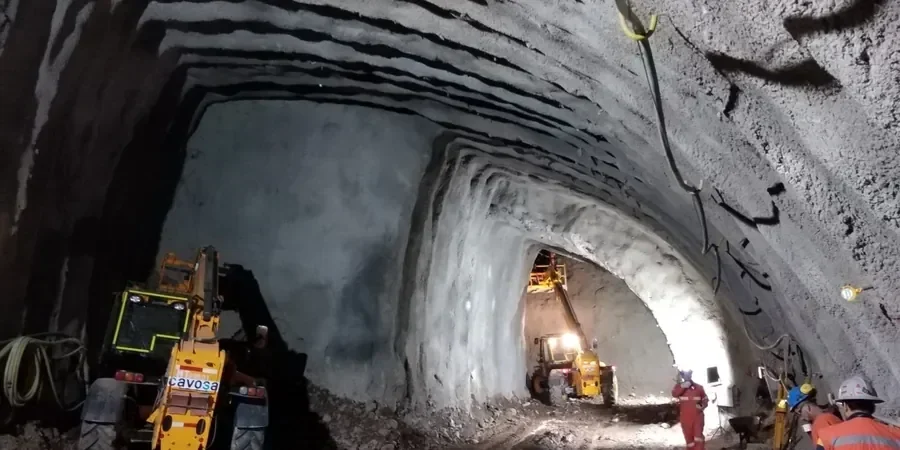
The Mercia Mudstone's swelling potential is often underestimated — it can exert up to 200 kPa on tunnel linings if not properly characterized.
Process overview
Local context
Eurocode 7 (EN 1997-1:2004) sets the framework for our geotechnical analysis in Derby. Its relevance here is high because the soft ground requires rigorous limit state design. The biggest risk in these tunnels is a face collapse driven by the low cohesion of the saturated mudstone. Water ingress along gypsum seams can rapidly destabilize the heading. We model the worst-case scenarios: a full-face collapse during construction or excessive long-term settlement of the overlying infrastructure. Our analysis quantifies the probability of these events and prescribes mitigation measures like face support pressures and pre-drainage systems.
Regulatory framework
EN 1997-1:2004 (Eurocode 7), BS 5930:2015 (Code of practice for ground investigations), BS EN 1997-2:2007 (Ground investigation and testing), CIRIA C760 (Guidance on embedded retaining walls)
Additional services
Ground Investigation & Parameter Derivation
Rotary coring through the Mercia Mudstone to obtain undisturbed samples. We then conduct a full laboratory program including triaxial, oedometer, and index tests. The output is a set of design parameters for tunnel lining and face stability analysis.
Numerical Modeling & Risk Assessment
Using finite element software (PLAXIS) to simulate the tunnel advance. We model face pressures, ground movements, and lining stresses. The analysis covers SLS and ULS conditions per Eurocode 7, with specific attention to the mudstone's swelling behavior.
Typical parameters
Questions and answers
What is the typical cost range for a geotechnical analysis for a soft soil tunnel in Derby?
The cost for a comprehensive geotechnical analysis for a soft soil tunnel in Derby typically ranges from £2,870 to £15,020. This depends on the tunnel length, the number of boreholes, and the complexity of the laboratory testing required. Contact us for a detailed quote based on your project scope.
How long does a typical ground investigation for a Derby tunnel take?
A standard investigation involving two boreholes with rotary coring and a full suite of lab tests takes between 4 and 6 weeks. This includes mobilisation, drilling, sample transport, and laboratory analysis. Deeper or more variable ground can extend the timeline.
What are the main hazards of tunneling in Mercia Mudstone?
The primary hazards are face instability due to low undrained shear strength, water ingress along gypsum veins, and long-term swelling pressures on the lining. The mudstone can also have high plasticity, making it sticky and difficult to excavate with tunnel boring machines.
Do I need a numerical model for a short tunnel in Derby?
We recommend it for any tunnel where settlement of adjacent structures is a concern. Even a short tunnel can cause 10-30 mm of surface settlement, which may damage heritage buildings in Derby's city centre. A simple 2D model is often sufficient for short lengths.
What design parameters do you provide for the tunnel lining?
We deliver the undrained shear strength (cu), the drained friction angle (phi'), the stiffness modulus (E'), and the swelling pressure. These are derived from laboratory tests on representative samples. We also deliver the at-rest earth pressure coefficient (K0) for the mudstone.