Derby sits on a mix of Mercia Mudstone, river terrace gravels, and made ground from its industrial past. That variation makes it essential to test soil strength before designing foundations or retaining walls. A triaxial test measures how soil behaves under controlled confining pressure. We run these tests in our UKAS-accredited lab following BS 1377:1990. The results give you effective cohesion and friction angle – the parameters needed for bearing capacity and slope stability analysis. For sites near the River Derwent, where groundwater fluctuates, we also recommend combining this with a clasificación de suelos to classify the material properly.
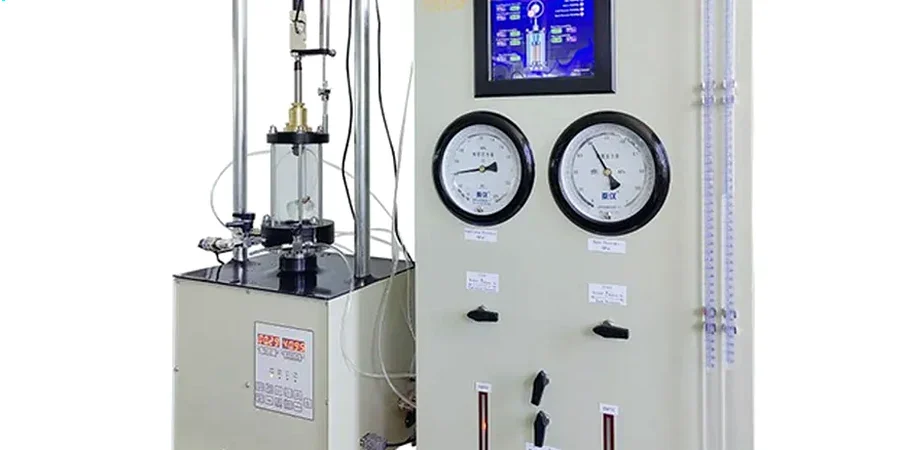
For Derby's Mercia Mudstone and river terrace gravels, the triaxial test gives you the effective stress parameters your design engineer needs.
Process overview
Local context
Many contractors in Derby rely on SPT N-values alone to estimate shear strength. That works for granular soils, but for the stiff clays and made ground common across the city, SPT correlation can overestimate strength by 30%. A triaxial test gives you direct measurement, not a correlation. Without it, you risk designing foundations that settle more than predicted, especially on fill sites near the city centre. We see this repeatedly in Derby. The cost of a test is small compared to a remedial underpinning job.
Regulatory framework
BS 1377:1990 Part 7 (triaxial test methods), Eurocode 7 (EN 1997-1:2004) – design approach 1, BS 1377-7 (UU test), BS 1377-8 (CU test with pore pressure)
Additional services
UU Triaxial Test (Quick Test)
For rapid assessment of undrained shear strength in saturated clays. Common on Derby residential developments where shallow foundations are being designed. Results in 24–48 hours from sample receipt.
CU Triaxial Test with Pore Pressure
The preferred method for Derby's variable soils. Measures effective stress parameters for slope stability, retaining walls, and deep foundations. Includes stress path plotting and Bishop's pore pressure parameter.
Typical parameters
Questions and answers
How much does a triaxial test cost in Derby?
A standard CU triaxial test with three specimens typically costs between £1,450 and £2,320, depending on specimen size and whether pore pressure measurement is required. UU tests are slightly lower. Volume discounts apply for multiple sample sets from the same site.
What is the difference between UU, CU, and CD triaxial tests?
UU applies fast loading without drainage – it measures undrained strength. CU allows consolidation under confining pressure, then shears with drainage closed but measures pore pressure. CD allows full drainage during shearing – it gives drained strength parameters. For Derby clays, CU is the standard choice.
How long does it take to get results?
UU tests are typically completed in 2–3 working days. CU tests take 5–7 working days because of the consolidation stage. We can prioritise urgent Derby projects with a 48-hour turnaround on CU tests for an additional fee.
Do you collect samples from Derby sites?
Yes, we offer site sampling using thin-walled tubes for undisturbed samples. Our technicians travel to Derby and follow BS 1377 sampling procedures. We also accept samples delivered to our lab. Contact us to arrange collection.
Which Derby soil types are most suitable for triaxial testing?
The Mercia Mudstone and river terrace clays respond well to triaxial testing because they maintain cohesion under confinement. Made ground and fill soils are also suitable, but we recommend a larger specimen diameter (100 mm) to account for heterogeneity.