The River Derwent and Trent Valley floodplain give Derby a varied subsurface profile, with alluvial sands and gravels overlying Mercia Mudstone bedrock. Groundwater often sits within 3 to 5 metres of the surface, which makes retaining deep excavations a real challenge. For projects requiring a watertight perimeter with high structural stiffness, diaphragm wall design becomes the go-to solution. Before specifying wall thickness or reinforcement, we always review the local stratigraphy and couple it with a calicatas exploratorias programme and ensayo SPT data to confirm soil strength and groundwater behaviour across the site.
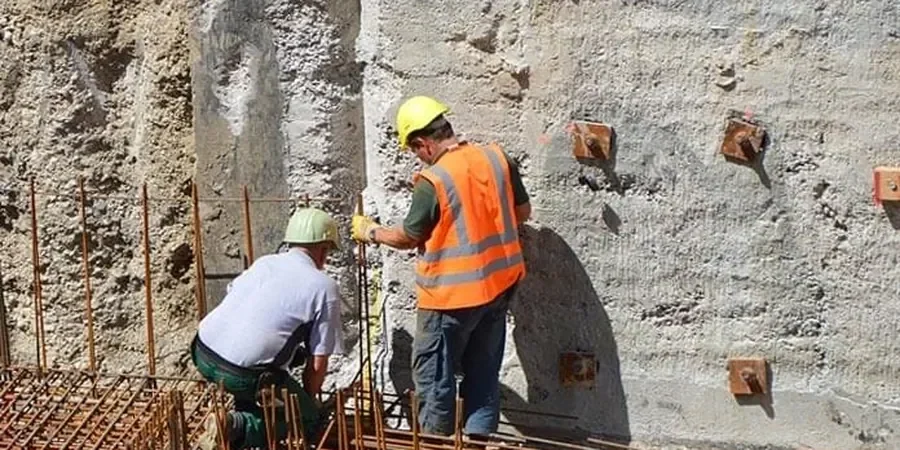
Panel layout in Derby's alluvial gravels must anticipate cobble obstructions and an uneven mudstone surface to keep wall continuity intact.
Process overview
Local context
A recent multi-storey car park near Derby city centre required a 14 m deep basement inside a tight urban footprint. The diaphragm wall had to cut through the water-bearing gravels and key into the Mercia Mudstone. During panel excavation, one section encountered a buried sandstone band that caused the grab to deviate. We stopped the pour, realigned the panel and re-excavated. Without that contingency procedure the wall could have developed a water path through the joint. That's the kind of local risk we design for from day one.
Regulatory framework
Eurocode 7 – EN 1997-1:2004, BS EN 1538:2010 – Execution of diaphragm walls, CIRIA C760 – Guidance on embedded retaining walls, BS 5930:2015 – Code of practice for ground investigations
Additional services
Feasibility and Panel Layout
Review of borehole logs, groundwater monitoring data and adjacent structures to define panel geometry, slurry specification and toe level. We flag potential obstructions such as buried sandstone or boulders early.
Structural Design and Reinforcement Detailing
Calculation of bending moments, shear capacity and crack widths under ULS and SLS. We produce reinforcement cage designs with couplers and lifting points optimised for the rig capacity available on site.
Construction Support and Quality Control
On-site supervision during panel excavation, desanding of slurry, concreting and cage installation. We review tremie records and carry out sonic logging to verify wall integrity after the pour.
This service complements our laboratory testing work for a complete project analysis.
Typical parameters
Questions and answers
What is the typical cost range for diaphragm wall design in Derby?
For a medium-depth wall between 10 and 20 m deep, the design fee typically falls between £1.400 and £5.890 depending on panel count, complexity of ground conditions and the level of construction support required. Contact us with your project dimensions for a fixed price.
How deep can a diaphragm wall go in Derby's alluvial soils?
In Derby, the practical working depth is around 30 m using a hydraulic grab, provided the rig can reach the site. Below that, the Mercia Mudstone becomes too hard for a grab and a hydrofraise or reverse-circulation rig may be needed, which increases both cost and programme.
Do I need a diaphragm wall or a secant pile wall for my Derby basement?
Both systems deliver a watertight cut-off. Diaphragm walls give a smooth finish and higher stiffness, which suits deep basements with multiple floors. Secant piles are faster to install on irregular footprints and work well when the wall depth is less than 12 m. We can advise after a quick review of your geometry and groundwater level.
What ground investigation is needed before diaphragm wall design?
We need boreholes every 30 to 50 m along the wall alignment, taken to at least 5 m below the proposed toe. SPTs every metre, together with groundwater monitoring and triaxial tests on the mudstone, give us the strength and stiffness parameters required for Eurocode 7 design.