Derby sits on a mixed geology of Mercia Mudstone and river terrace deposits along the Derwent, and the clay horizons here are famously reactive—shrink-swell behaviour causes real headaches for pavements and shallow foundations. That is why lime and cement stabilization is often the most cost-effective fix before placing structural fill or a capping layer. We treat the soil in-situ or ex-situ, reducing plasticity and increasing bearing capacity so the platform works as designed. When the clay content is high, combining lime modification with a cement binder produces a material that meets the spec for highways and industrial slabs. Before mixing, we always run a granulometría and Atterberg limits to confirm the treatment dosage—getting the percentages wrong means either wasted binder or a platform that still moves.
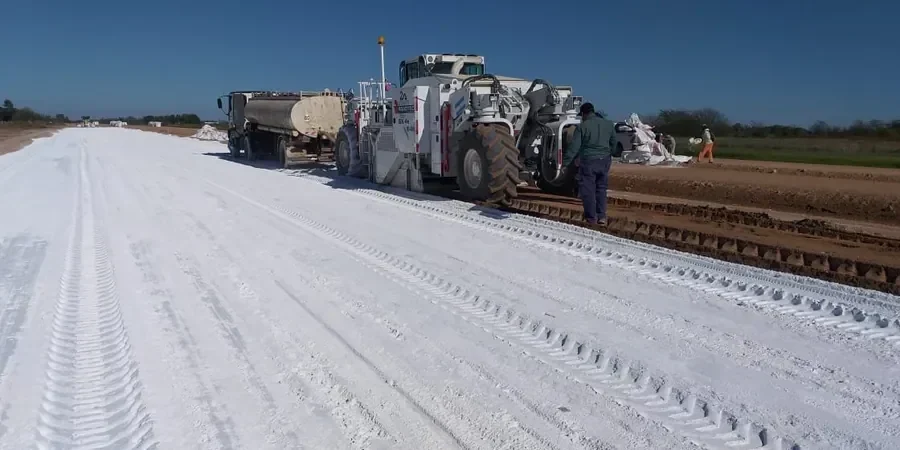
Lime dries the clay and cuts the plasticity index; cement locks in the strength. Without both, Derby's shrink-swell soils will keep moving.
Process overview
Local context
What we see most in Derby is projects that skip the stabilization step to save a few weeks, then end up with differential settlement in the first year. The Mercia Mudstone clay is not forgiving—it wets up fast in the Derbyshire rain and loses all bearing capacity. If you pave or pour a slab directly on untreated clay, you get cracking and ride quality complaints. In our track record, the worst-case scenario is a dual carriageway built on high-PI clay in winter: the subgrade heaves, the pavement fails within two seasons, and the remediation cost is three times what the stabilization would have been. We always recommend doing a trial strip first with the actual site soils to confirm the mix design works before scaling up.
Regulatory framework
BS EN 16907-4:2018 (Earthworks – Soil treatment with lime and/or cement), Eurocode 7 – EN 1997-1:2004 + UK National Annex, BS 5930:2015 (Code of practice for ground investigations), SHW Series 600 (Specification for Highway Works – Earthworks)
Additional services
Laboratory Mix Design & Dosage Optimisation
We test the site soil to determine the optimum lime and cement percentages. Eades & Grim pH test, Atterberg limits, compaction characteristics (BS 1377), and unconfined compressive strength at 7 and 28 days.
In-Situ Stabilisation (Road Mixing)
Large-scale rotavator mixing for platforms, car parks and highways. We apply binder at the calculated rate, mix to depth (up to 350 mm), compact to target density, and cure. Proof rolling and field CBR tests verify the platform.
Ex-Situ Treatment & Re-Use of Site Won Material
For confined sites or when the existing clay needs to be removed and re-placed, we batch-mix the soil with lime and cement in a pugmill, then lay, compact and cure. This gives tighter control of binder distribution and moisture content.
This service complements our laboratory testing work for a complete project analysis.
Typical parameters
Questions and answers
How much does lime and cement stabilization cost in Derby?
For a typical housing development platform in Derby, the cost ranges between £640 and £1,700 per m³ of treated soil, depending on the clay plasticity, binder dosage, layer thickness and site access. The lower end applies to large flat sites with standard PI clay; the higher end covers small brownfield plots with contaminated material or difficult access.
What is the difference between lime stabilization and cement stabilization?
Lime reacts with the clay minerals to reduce plasticity and dry the soil – it is a modification rather than a structural binder. Cement hydrates and forms a rigid matrix that gives significant compressive strength. In many Derby clays, we use lime first to bring the PI down, then add cement to achieve the required CBR and UCS. The two are complementary, not interchangeable.
How long does the treatment take to cure before I can pave or build on it?
After compaction, the treated layer needs a curing period of typically 7 days for light traffic (proof rolling) and 28 days for full design strength. During that time, we keep the surface moist-cured to prevent desiccation cracking. If the weather is cold and wet, curing may take longer – we monitor in-situ moisture and temperature to decide when the platform is ready.