A three-storey office block near Derby's Pride Park was showing visible cracking in its brick cladding just two years after completion. The cause was differential settlement: the fill material beneath one corner had consolidated unevenly. For any structure built on Derby's fluvial terrace deposits or Mercia Mudstone formations, a proper settlement analysis is the only way to predict how much the ground will move under load. We combine oedometer tests with numerical modelling to estimate total and differential settlement, then cross-reference results against the allowable limits in Eurocode 7. Before finalising foundation design, our team also runs a plate load test on site to verify modulus of subgrade reaction values and a consolidation test on undisturbed samples to determine the coefficient of consolidation cv.
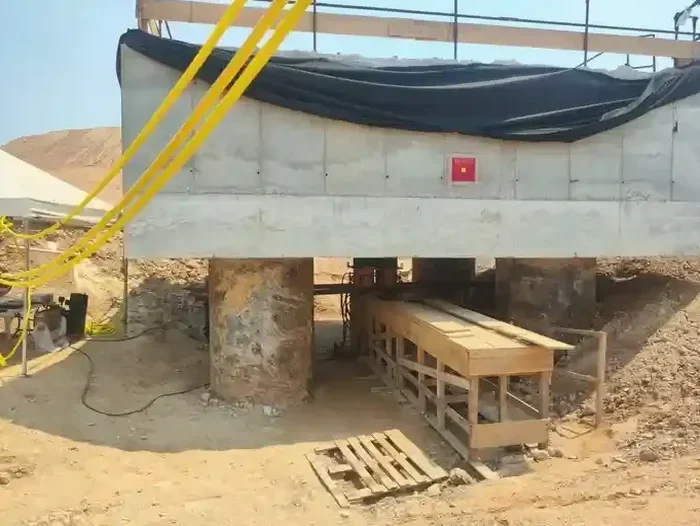
Differential settlement, not total settlement, causes most structural damage in Derby — we design to limit angular distortion below 1/500.
Process overview
Local context
Eurocode 7 (BS EN 1997-1:2004) mandates that serviceability limit states be checked for every foundation design. In Derby, the main risk is not total settlement exceeding 50 mm — it is differential settlement. A building founded partly on competent river terrace gravels and partly on soft alluvial clay can track record angular distortions of 1/200 or more, which exceeds the 1/500 threshold for masonry walls. We have seen cases where ignoring the lateral variability of the ground led to floor slabs tilting by 30 mm across a warehouse span. Our settlement analysis identifies these transition zones early, allowing the structural engineer to specify stiffened rafts or losa de cimentación designs that redistribute loads evenly across the footprint.
Regulatory framework
BS EN 1997-1:2004 (Eurocode 7 – Geotechnical design, serviceability limit states), BS 5930:2015 (Code of practice for ground investigations), BS 1377-5 (Standard test methods for one-dimensional consolidation properties of soils), CIRIA C760 (Guidance on embedded retaining walls and settlement assessment)
Additional services
Consolidation & Oedometer Testing
Laboratory tests on undisturbed U100 samples from Derby clay and silt strata to determine compression index Cc, recompression index Cr, and coefficient of consolidation cv. Results inform both immediate and long-term settlement predictions.
Numerical Settlement Modelling
Finite-element analysis using PLAXIS 2D to simulate load-deformation behaviour under strip footings, pad foundations, or raft slabs. We model soil layering based on Derby-specific borehole logs and calibrate with field plate load test data.
Differential Settlement Risk Mapping
Geospatial assessment of lateral ground variability across a site. We overlay historical map data, BGS borehole records, and our own test pit observations to highlight zones where sudden changes in soil stiffness could cause unequal movement.
Typical parameters
Questions and answers
What is the difference between total settlement and differential settlement?
Total settlement is the overall downward movement of a structure, measured in millimetres. Differential settlement is the difference in movement between two points on the same foundation — it is the angular distortion that causes cracking. Eurocode 7 limits angular distortion to 1/500 for framed buildings and 1/300 for open steel frames. Our analysis in Derby always evaluates both values.
How much does a settlement analysis cost for a typical Derby residential project?
For a standard detached house on a greenfield site in Derby, a settlement analysis including oedometer testing and a brief numerical report ranges between £530 and £1,300. Larger commercial developments with multiple boreholes and 3D modelling can exceed this range. We deliver a fixed quotation after reviewing the site's ground conditions and structural loads.
Can settlement occur years after construction in Derby's clay soils?
Yes. Primary consolidation in Derby's alluvial clays can take months to years depending on the drainage path. Secondary compression (creep) can continue for decades under sustained loads. We account for this by measuring the secondary compression index Cα in long-duration oedometer tests and including it in our time-settlement curves.
Do I need a settlement analysis if the ground looks firm?
Visual inspection of the surface is not reliable. In Derby, firm-looking topsoil can overlie soft alluvial clay or loose fill. Without a settlement analysis, you risk differential movement that cracks partitions, jams doors, and compromises the building's structural integrity. We recommend a minimum of one oedometer test per distinct soil layer even for small extensions.