Derby sits on the Trent Valley floodplain, underlain by river terrace gravels, alluvial clays, and pockets of glacial till. Ground conditions vary significantly between the city centre and the industrial estates along the A38 corridor. For containment projects — landfill cells, lagoon liners, or secondary containment bunds — the geomembrane specification must account for subgrade stiffness, puncture resistance from angular gravels, and long-term chemical compatibility with site leachates. We combine site-specific data with GRI test methods to select the right thickness, texture, and polymer type. Before finalising the liner grade, we often run a compression simple test on the subgrade to confirm bearing capacity under the confining layer, and a granulometria analysis to assess the risk of puncture from coarse particles.
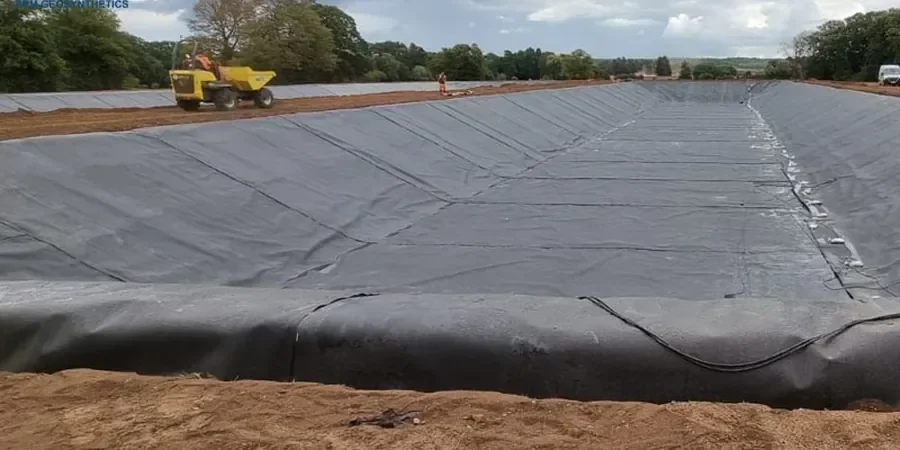
For landfill liners in the Trent Valley, the subgrade's alluvial clay can be soft — we always check CBR before specifying the geotextile cushion layer.
Process overview
- Thickness selection (1.0 mm to 2.5 mm) based on hydraulic head and installation stress.
- Textured vs. smooth surface for slope stability on embankments steeper than 1V:2.5H.
- UV stabilisation and antioxidant packages for exposed applications.
- Seam strength testing (wedge, extrusion, or hot wedge) per BS 1377.
Local context
In Derby, one recurring issue we see is the presence of shallow groundwater within the alluvial gravels — during heavy rainfall the water table rises within 1.5 m of the surface. If the geomembrane specification does not include a gas venting layer or a suitable drainage geocomposite, hydrostatic uplift can balloon the liner and cause seam failure. Another risk is differential settlement on filled ground: old railway embankments and demolition rubble can settle unevenly, stretching the liner beyond its elongation limit. We address this by specifying a reinforced geomembrane (scrim-reinforced fPP) and requiring a proof-rolled subgrade with documented CBR ≥ 3% before liner placement.
Visual overview
Regulatory framework
GRI-GM13 (HDPE geomembrane specification), GRI-GM17 (LLDPE geomembrane specification), BS EN 1997-2:2007 (Eurocode 7 – ground investigation and testing), BS 1377 (seam strength evaluation), CEN/TR 14414 (chemical resistance testing)
Additional services
Containment Liner Specification for Landfills & Lagoons
Full design specification for bottom liners, capping systems, and lagoon liners. Includes polymer selection (HDPE, LLDPE, or fPP), thickness optimisation, textured/smooth surface decision, seam qualification (wedge, extrusion), and subgrade acceptance criteria (CBR, smoothness, drainage). We prepare a GRI-GM13 compliant datasheet with all quality control hold points.
Secondary Containment & Bund Lining for Industrial Sites
Specification for chemical bunds, tank farm secondary containment, and process area liners. We assess the stored liquid's chemical composition, select the appropriate polymer (HDPE for hydrocarbons, fPP for high-temperature liquids), and define the required thickness, UV stabilisation, and leak detection layer. All specifications reference CIRIA C736 and EA guidelines for the UK.
Typical parameters
Questions and answers
What thickness of HDPE geomembrane is typically specified for landfill liners in Derby?
For municipal solid waste landfill bottom liners, we typically specify 2.0 mm HDPE textured on one side (GRI-GM13). For capping systems, 1.5 mm smooth HDPE is common. The thickness is driven by the waste height (up to 30 m in Derbyshire landfills) and the required factor of safety against puncture from the drainage gravel.
What is the difference between smooth and textured geomembranes, and when should each be used?
Smooth geomembranes are used on flat surfaces or gentle slopes (≤1V:3H) where interface friction is not critical. Textured geomembranes (single or double side) are specified for slopes steeper than 1V:3H to increase the interface friction angle between the liner and the geotextile or soil. In Derby's landfill designs, we use double-side textured HDPE for slopes up to 1V:2H.
What is the typical cost range for a geomembrane specification service in Derby?
The specification service typically ranges between £450 and £1,500, depending on project complexity, number of polymer types evaluated, and whether seam qualification testing is included. For simple lagoon liners the cost is at the lower end; for multi-liner landfill cells with chemical resistance testing it is at the upper end.
How do Derby's alluvial soils affect the geomembrane specification?
The alluvial gravels and clays in the Trent Valley have variable bearing capacity and can contain sharp flint fragments. We require a CBR ≥ 3% and a smooth, compacted subgrade before liner placement. A geotextile cushion (typically 600 g/m² non-woven) is always specified to protect the geomembrane from puncture. If the subgrade is very soft, we may specify a thicker liner (2.5 mm) or a reinforced product.