Derby sits on a complex geological patchwork – Triassic sandstones and mudstones of the Mercia Mudstone Group overlain by river terrace deposits from the Derwent and Trent. The high groundwater table in the Derwent floodplain, combined with these variable strata, makes jet grouting design a go-to solution for creating low-permeability cut-off walls and improving bearing capacity under existing foundations. Before finalising the column layout, we always run a classification of soils to map the fines content across the site, as clay-rich pockets directly influence grout take and column diameter. Our team has handled this sequence across Derby's industrial zones and city-centre redevelopments.
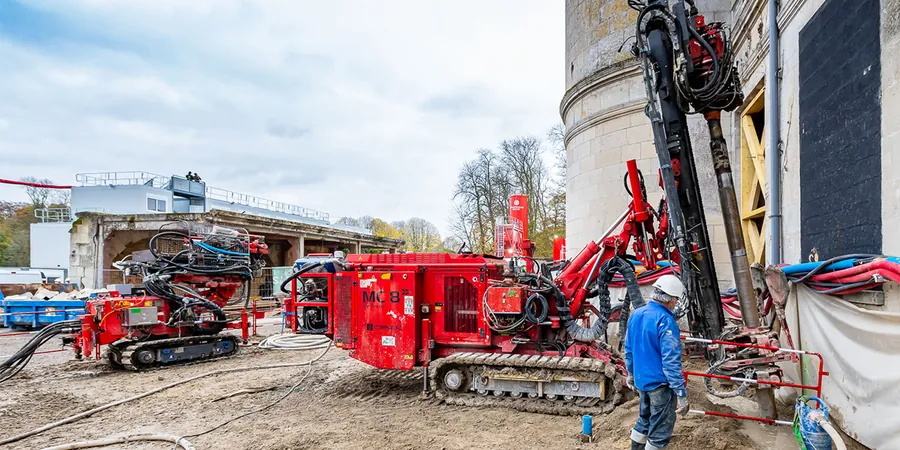
Jet grouting design for Derby's high water table demands trial columns and real-time UCS verification before full-scale production.
Process overview
Local context
Derby's recorded rainfall exceeds 700 mm annually, and the Derwent regularly floods the low-lying eastern districts. A jet grouting design that ignores lateral groundwater flow risks incomplete column formation and preferential erosion of the grout curtain. We mitigate this by specifying a minimum overlap of 30% column diameter in the design phase and by correlating real-time grout returns with pressure logs. Our UKAS-accredited procedures (ISO 17025) ensure traceability from mix design to cured-core testing, reducing the likelihood of hidden defects in the treated mass.
Regulatory framework
BS EN 1997-1:2004 (Eurocode 7 – Geotechnical design), BS 5930:2015 (Code of practice for ground investigations), CIRIA C579 (Jet grouting – a guide for engineers), BS 5930 (Standard practice for design and installation of groundwater monitoring wells – relevant for grout curtain verification)
Additional services
Underpinning & foundation strengthening
For existing structures on Derby's river terraces where differential settlement is a concern, we design jet grout columns beneath strip footings or pad foundations. The columns transfer loads to the underlying sandstone, bypassing the soft alluvial layer.
Cut-off walls & excavation support
Where basement excavations approach the water table, we design secant jet grout panels to create a low-permeability barrier. This allows dry excavation within the city centre without dewatering the surrounding groundwater.
Typical parameters
Questions and answers
What is the typical cost range for jet grouting design in Derby?
For a standard residential or commercial project in Derby, the design and testing phase typically falls between £1,370 and £5,550, depending on the number of trial columns, target depth, and required laboratory validation.
How deep can jet grout columns reach in Derby's ground conditions?
In the Mercia Mudstone and overlying river deposits, we have successfully designed columns up to 25 metres deep. Deeper applications require careful assessment of rod deviation and grout return pressures.
What strength can I expect from jet grout columns in Derby?
Target unconfined compressive strength at 28 days is typically between 2 and 15 MPa, depending on the native soil type and the water/cement ratio used. Trial columns are essential to confirm the achieved strength.
How long does the jet grouting design process take?
From initial site data review to final column layout and specification, expect 2 to 4 weeks. Trial column installation and curing add another 3 to 4 weeks before full-scale production begins.
Do you need a full ground investigation before jet grouting design?
Yes. A minimum of boreholes with SPT and groundwater monitoring is essential to map strata boundaries and water levels. We can incorporate existing investigation data if it meets BS 5930 requirements.