Derby sits on the River Derwent floodplain, where alluvial clays and silts dominate the subsurface. These soft, compressible soils pose a real challenge for any new development — from housing estates to industrial units. Preloading with surcharge design in Derby directly tackles this by applying a temporary load to accelerate consolidation before permanent construction begins. The method reduces long-term settlement, saving time and money on foundation repairs later. Before designing the surcharge sequence, engineers must run a full study of soil mechanics to determine consolidation coefficients and undrained shear strength. Without that data, any preload plan is guesswork.
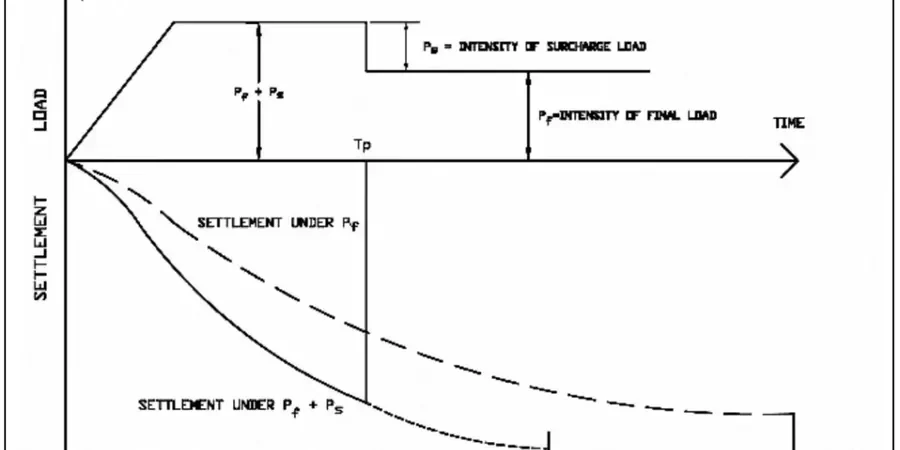
Preloading with surcharge design turns soft Derby ground into a stable platform — but only if the consolidation parameters are measured, not guessed.
Process overview
- Assessment of pre-consolidation pressure via oedometer tests
- Selection of surcharge height based on target effective stress
- Installation of settlement monitoring points at key locations
Local context
The main risk in Derby is underestimating consolidation time. If the preload is removed too early, the ground will settle post-construction — cracking slabs, tilting foundations, and ruining finishes. The second risk is drainage: if the clay layer is thick and no vertical drains are installed, consolidation may stall. The third is overloading the soft clay before it gains shear strength, causing a bearing failure. Each of these can be managed with proper instrumentation and staged loading. An experienced laboratory team will run oedometer tests to measure cv and mv precisely, and field data from settlement plates will confirm when to remove the surcharge.
Regulatory framework
Eurocode 7 (EN 1997-1:2004), BS 5930:2015 Code of practice for site investigations, BS EN 1997-2:2007 Ground investigation and testing
Additional services
Consolidation Testing (Oedometer)
Multi-stage oedometer tests to determine cv, mv, and pre-consolidation pressure. Essential for designing the surcharge height and duration.
Settlement Monitoring
Installation and reading of settlement plates, piezometers, and inclinometers. Real-time data to track consolidation progress and confirm when to remove the surcharge.
Vertical Drain Design
Combining preloading with vertical drains for faster consolidation. We specify drain spacing, depth, and type based on Derby's soil stratigraphy.
Typical parameters
Questions and answers
How much does preloading with surcharge design cost in Derby?
A typical preloading design package — including oedometer testing, settlement analysis, and a monitoring plan — ranges from £640 to £1,760. Final cost depends on site size and the number of boreholes or test pits required.
How long does the preloading process take on Derby clay soils?
For a 3-metre thick clay layer with single drainage, expect 6 to 12 months to reach 90% consolidation. Installing vertical drains can reduce this to 3–4 months. The exact duration comes from the oedometer test results and the chosen surcharge height.
Do I need planning permission for a surcharge embankment in Derby?
Most surcharge embankments under 3 metres height on brownfield land do not require planning permission, but you must check with Derby City Council's building control. We always recommend a pre-application enquiry to avoid delays.