Seismic foundation design in Derby must follow Eurocode 7 (BS EN 1997-1:2004) and the National Annex. Derby sits on variable alluvial and glacial till deposits, which can amplify ground motion during an earthquake. The UK is a low-seismicity region, but local site effects matter. We assess shear-wave velocity profiles and soil stiffness to define the ground type. Before finalising the structural model, we often run a microzonificación sismica study to map potential amplification zones across the site. This data feeds directly into the foundation design parameters.
Derby's alluvial and till deposits can amplify seismic waves. We measure Vs30 and cyclic strength to design safe foundations under Eurocode 7.
Process overview
Local context
Derby lies about 60 km from the nearest active fault zone in the East Midlands. The largest recorded earthquake in the region was the 2008 Market Rasen event (4.7 ML), felt across Derby. Even moderate shaking can trigger differential settlement in buildings founded on soft alluvium or loose fills. The risk is low but real – especially for tall structures or those with irregular geometry. We evaluate liquefaction potential using the NCEER method (Youd-Idriss, 2001) and assess cyclic softening in cohesive soils. Seismic foundation design in Derby reduces these risks by matching foundation stiffness to the expected ground motion.
Regulatory framework
Eurocode 7 (BS EN 1997-1:2004) – Geotechnical design, BS EN 1998-5:2004 – Seismic design of foundations, retaining structures and geotechnical aspects, NEHRP Recommended Provisions (FEMA P-1050) – Site classification and Vs30 criteria
Additional services
Site-specific seismic response analysis
Including Vs30 measurement via MASW, cyclic triaxial testing, and one-dimensional ground response analysis. We use the equivalent-linear method (SHAKE) to compute acceleration profiles and design spectra for the site.
Foundation type recommendation and verification
Based on the seismic response, we recommend shallow foundations, piled rafts, or deep piles. We verify bearing capacity, sliding resistance, and overturning under seismic loads per Eurocode 7 and 8.
Typical parameters
Questions and answers
What is the typical cost range for a seismic foundation design study in Derby?
A full study including field tests, lab work, and design report ranges between £980 and £3,620, depending on site size and complexity. The final cost is confirmed after an initial scoping visit.
How does Vs30 affect foundation design in Derby?
Vs30 defines the ground type under Eurocode 8 (A, B, C, D or E). A lower Vs30 means softer soil, which amplifies motion. For Derby's alluvial sites (class C/D), we increase the design spectrum and often recommend deeper piles to bypass the softer layers.
Can an existing building in Derby be retrofitted for seismic loads?
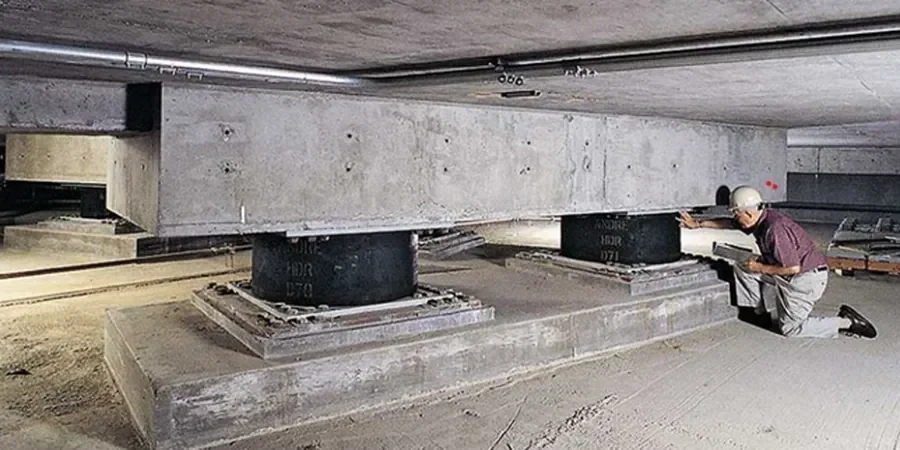
Yes. We first assess the current foundation capacity and soil profile. Then we design retrofit solutions such as Improvement, pile underpinning, or base isolation. The approach depends on the building's age, material, and occupancy.