Derby’s geology shifts noticeably between the alluvial floodplain of the River Derwent and the higher ground around Allestree. The valley floor typically holds soft clays and sands overlying Mercia Mudstone, while the slopes feature stiffer glacial tills. An exploratory test pit in Derby provides direct visual access to these layers, allowing engineers to log soil types, measure groundwater seepage, and sample for laboratory classification. This method is particularly useful when assessing shallow foundation conditions in residential zones near Mickleover or industrial sites along the A38 corridor. Before any bulk excavation, a test pit survey helps avoid surprises — especially where historical fill or shallow coal workings might exist. Complementing the visual inspection with a classification of soils ensures the strata are correctly identified under BS 5930.
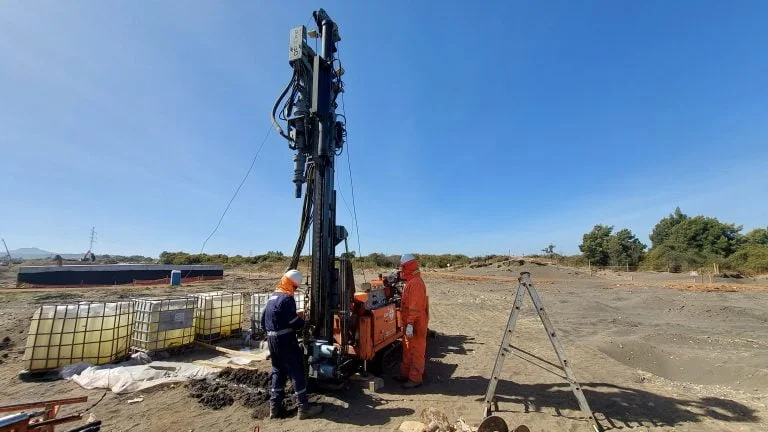
Direct visual logging of Derby's glacial tills and Mercia Mudstone is the surest way to avoid foundation claims on residential sites.
Process overview
- Disturbed and undisturbed samples for moisture content and density.
- Field pocket penetrometer readings on cohesive layers.
- Photographic records of each stratum for the factual report.
Local context
Derby’s urban expansion since the 19th century has created zones of variable made ground, particularly around the former railway yards and industrial works near the Derwent. An exploratory test pit in Derby directly exposes these hidden layers — old foundations, ash fill, or coal waste — that could cause differential settlement. The city also sits partly on low-lying floodplain, where shallow groundwater can soften excavation sides and require dewatering. Identifying soft spots or buried obstructions early through test pitting reduces the risk of redesign during foundation construction. For sites with steep side slopes, a concurrent slope stability assessment is recommended when the pit reveals weak clay layers.
Visual overview
Regulatory framework
BS 5930:2015 — Code of practice for ground investigations, BS EN 1997‑1:2004 (Eurocode 7) — Geotechnical design, Manual of Contract Documents for Highway Works (MCHW) Series 600
Additional services
Standard Exploratory Pit
Machine-excavated pit to 1.5–2.0 m depth with full visual logging, bulk sampling, and photographic record. Suitable for residential extensions and small commercial units.
Deep Test Pit with Standpipe
Extended excavation to 3.5 m where geology and groundwater allow, including installation of a monitoring standpipe for long-term water level readings.
Utility Location & Trial Pit
Hand-dug or machine-dug pit targeting buried service alignment. CAT scan and avoidance tool used before excavation. Logged per PAS 128:2022.
Bulk Sample Pit for Laboratory
Larger pit (3 m × 2 m) to obtain representative bulk samples for compaction, CBR, or chemical testing. Common for highway and earthworks projects.
Typical parameters
Questions and answers
How deep can an exploratory test pit go in Derby's ground conditions?
In Derby's glacial tills and Mercia Mudstone, test pits typically reach 1.5–2.5 m before groundwater or sidewall collapse becomes problematic. On the floodplain, perched water often limits depth to 1.2 m. Deeper pits require trench support or dewatering wells.
What is the typical cost range for a test pit in Derby?
For a standard exploratory test pit in Derby, expect a cost range of £430 – £760 including excavation, logging, sampling, and reinstatement. The final price depends on depth, number of pits, and any dewatering needed.
How does a test pit differ from a borehole for foundation design?
A test pit gives direct visual access to the soil profile — you see the actual strata, measure in-situ density, and inspect for voids or fill. Boreholes deliver deeper penetration but limited visual information. For shallow foundations in Derby, test pits are often more cost-effective and informative.
Can you work on occupied residential sites in Derby?
Yes. We use compact tracked excavators that access through standard gateways (0.9 m wide). All work is completed in one day, with full reinstatement using the arisings. We coordinate with the client to minimise disruption to gardens or driveways.
What standards govern test pit logging in the UK?
Logging follows BS 5930:2015, with soil description per the British Soil Classification System. Design parameters are derived under Eurocode 7 (BS EN 1997‑1:2004). For highway projects, we also comply with the MCHW Series 600 specification.