BS 5930 and Eurocode 7 demand accurate soil classification before any foundation design in Derby. The city's geology is a mix of river terrace deposits and Mercia Mudstone, creating variable grading profiles. Grain size analysis provides the particle distribution needed to classify soils correctly. For projects on the floodplain near the River Derwent, understanding the fine fraction is critical. We combine sieve analysis for coarse particles with hydrometer testing for silts and clays, ensuring compliance with BS EN 1997-2. This data directly informs decisions on drainage and compaction, and pairs well with a clasificación de suelos to define engineering behaviour. The procedure follows BS 1377-2 and BS 1377, adapted to local ground conditions.
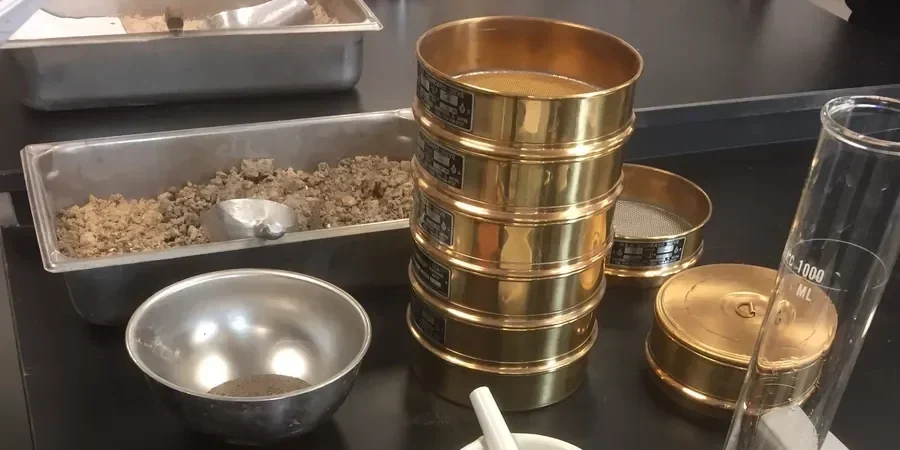
Grain size analysis in Derby's variable ground conditions is the first step to avoiding settlement issues in both residential and commercial foundations.
Process overview
Local context
A recent Derby housing development near the A38 encountered unexpected settlement after a wet winter. The contractor had assumed free-draining sand, but grain size analysis revealed over 30% silt content. That changed the drainage design completely. Without proper testing, the same scenario can lead to differential settlement in strip footings or clogged drainage layers. In Derby, where many sites sit on glacial till or alluvial deposits, the fine fraction is often underestimated. Relying on visual classification alone is a gamble. Grain size analysis removes that guesswork. It tells you exactly how much passes the 75-micron sieve and whether the soil is prone to capillary rise or frost heave. That information directly affects foundation depth and pavement design.
Regulatory framework
BS 5930:2015 (Code of practice for ground investigations), BS EN 1997-2:2007 (Eurocode 7 – Ground investigation and testing), BS 1377-2 (Standard test methods for particle-size distribution – sieve), BS 1377 (Standard test method for particle-size distribution – hydrometer)
Additional services
Dry Sieve Analysis
For clean sands and gravels where fines content is low. Uses a mechanical shaker with sieves from 75 mm down to 63 microns. Ideal for coarse fills and granular subgrades.
Wet Sieve Analysis
Recommended when fines exceed 5%. Water washing removes clay coatings from coarse particles, giving accurate grading. Essential for Derby's clay-rich glacial tills.
Hydrometer Analysis
Measures the percentage of silt and clay fractions below 63 microns. Uses Stokes' Law to determine sedimentation rates. Critical for assessing frost susceptibility and filter design.
Combined Sieve + Hydrometer
Full particle size distribution from cobbles down to 0.5 microns. Delivers a complete grading curve for soil classification per BS 5930 and USCS. Our most requested package for Derby developments.
This service complements our laboratory testing work for a complete project analysis.
Typical parameters
Questions and answers
Why is grain size analysis important for Derby construction projects?
Derby's soils vary widely from river terrace deposits along the Derwent to Mercia Mudstone on higher ground. Grain size analysis identifies whether you are dealing with sand, silt, clay, or a mix. This classification governs foundation type, drainage design, and compaction specifications. Without it, you risk selecting the wrong Improvement method or underestimating settlement.
What is the difference between sieve and hydrometer analysis?
Sieve analysis sorts particles larger than 63 microns by passing them through a stack of progressively finer mesh screens. Hydrometer analysis covers particles smaller than 63 microns by measuring how fast they settle in a water column. For Derby soils containing both sand and clay fractions, we typically run both tests to get the full grading curve.
How much does grain size analysis cost in Derby?
A standard combined sieve and hydrometer analysis in Derby typically ranges between £80 and £130 per sample. This price covers sample preparation, sieving, sedimentation, and a full grading curve report. Costs can vary depending on the number of samples and whether additional tests like Atterberg limits are requested together.
How long does a complete grain size analysis take?
Sieve analysis alone takes one working day. Hydrometer analysis requires up to 24 hours of settling time, so combined testing usually takes two working days. We prioritise urgent projects in Derby and can often deliver results within 48 hours for standard samples.