Derby grew fast during the Industrial Revolution, and its clay-rich soils underlain by Mercia Mudstone have always posed drainage challenges. When rain hits these low-permeability formations, water ponds on the surface or migrates laterally, softening the subgrade. Early railway engineers learned this the hard way, with embankment failures that delayed lines. Today, we apply that same lesson to road projects. Effective geotechnical road drainage is not an afterthought. It is a prerequisite for long-term pavement life. Our team evaluates infiltration rates, soil plasticity, and groundwater levels before designing any drainage element. We combine field permeability tests with laboratory data to predict how water will behave on your site. Then we size French drains, fin drains, or blanket drains accordingly. This approach prevents differential settlement and extends the service life of the carriageway.
A perched water table 1.8 m deep changed the drainage design on a Derby A-road widening. Field data prevents guesswork.
Process overview
Local context
Derby sits at roughly 55 m above sea level, but its topography is subtly undulating, creating natural drainage basins that concentrate runoff. The city receives about 650 mm of rain annually, with autumn storms often saturating the ground. In clay subgrades, a mere 2 % increase in moisture content can reduce California Bearing Ratio by half. Without proper geotechnical road drainage, that moisture stays trapped under the pavement. Freeze-thaw cycles in January further weaken the subgrade. We have seen road sections fail within three winters because the drainage layer was undersized. Our drainage designs include a safety factor of 1.5 on flow capacity to account for Derby's variable rainfall intensity.
Visual overview
Regulatory framework
BS 5930:2015 – Code of practice for ground investigations, Eurocode 7 (EN 1997-1:2004) – Geotechnical design, BS EN 13242 – Aggregates for hydraulic bound and unbound materials, Specification for Highway Works (SHW) Series 500 – Drainage
Additional services
Subgrade drainage design
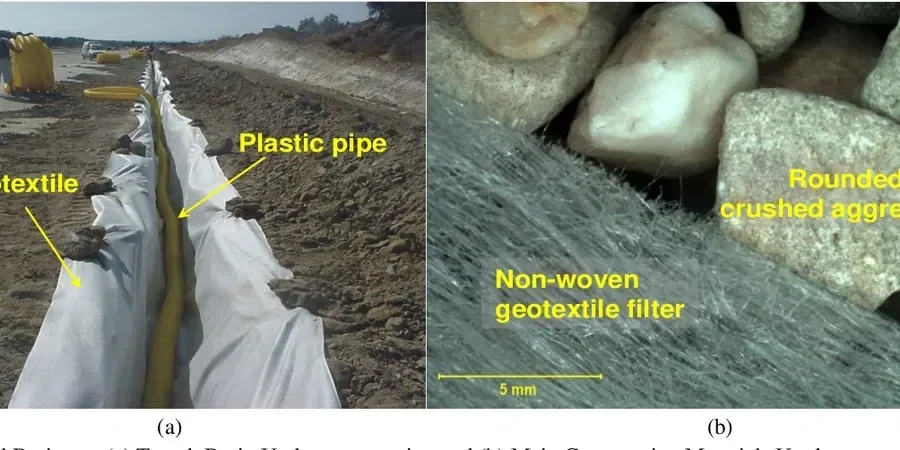
We calculate required drain spacing and depth based on soil permeability and traffic load. Designs include fin drains, trench drains, and blanket layers with geotextile separation.
Permeability testing in situ
Using falling-head tests in boreholes and open-pit infiltration tests, we measure the actual hydraulic conductivity of Derby's Mercia Mudstone and alluvial deposits.
Drainage layer specification
We select filter stone gradation and geotextile type to prevent clogging. Our specs comply with SHW Series 500 and include long-term flow capacity checks.
Typical parameters
Questions and answers
What is the typical cost for a geotechnical road drainage study in Derby?
A full drainage assessment including site walkover, two test pits, permeability testing, and a design report typically ranges from £680 to £2,250. Final price depends on the number of test locations and site access conditions.
How deep should a drainage trench be for a Derby road project?
Trench depth depends on the depth of the subgrade layer and the groundwater level. In Derby's clays, we usually specify trenches 0.8 m to 1.5 m deep, with the invert at least 0.3 m below the pavement sub-base. We confirm this after test pit logging.
Do I need a geotechnical drainage design for a small access road?
Yes. Even a short access road on clay subgrade will fail without effective drainage. We have seen 40 m long drives develop longitudinal cracks after two winters because no fin drain was installed. A simple design prevents costly repairs.
What standards do you follow for drainage design in Derby?
We design to Eurocode 7 (EN 1997-1:2004) and the Specification for Highway Works Series 500. All ground investigation follows BS 5930:2015. Our laboratory tests are UKAS-accredited to ISO 17025.