Derby’s subsurface is a mosaic of river terrace gravels, glacial till, and Mercia Mudstone bedrock, often capped by variable made ground from centuries of industrial activity. This geological mix creates challenging conditions for any deep foundation system. Micropile design in Derby must account for the high lateral variability: a borehole 10 metres away can encounter completely different soil stiffness or groundwater conditions. Before finalising the micropile layout, a thorough site investigation is essential, and we often recommend pairing it with a geotechnical study including SPT to profile the ground accurately. The design methodology follows Eurocode 7 (EN 1997-1:2004) and BS EN 1997-2:2007, ensuring that load-transfer mechanisms are verified against local ground conditions rather than generic assumptions.
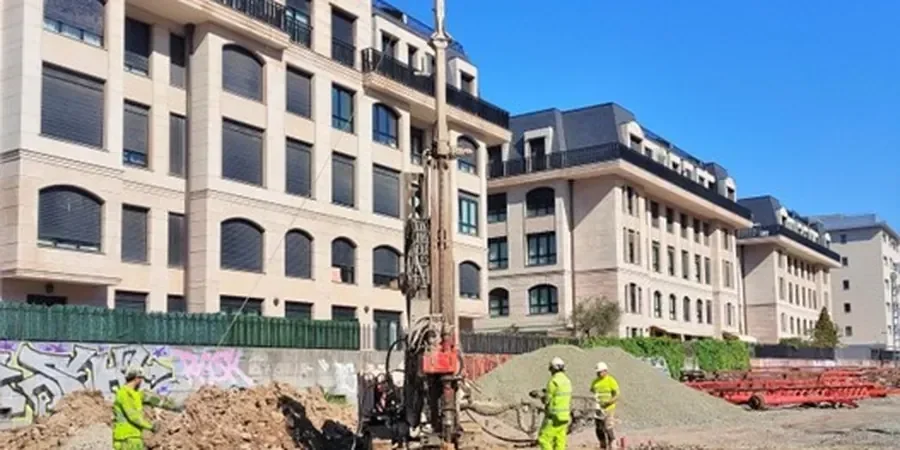
In Derby's alluvial terraces, a 1.5-metre error in assumed groundwater depth can halve the calculated bond strength of a micropile.
Process overview
- Case capacity verification using the FHWA method for axial compression and tension loads.
- Corrosion protection design per BS EN 14199:2015, critical for Derby’s brownfield sites with potential chemical aggressivity.
- Group efficiency analysis when piles are spaced closer than 3 diameters centre-to-centre.
Local context
Derby sits at an elevation averaging 55 m above sea level, but its floodplain areas along the Derwent are only 35 m. The city experienced significant flooding in 2019 and again in 2020, events that saturate made ground and reduce effective stress in foundation soils. For micropile design in Derby, the principal risk is a loss of bond capacity in the upper 3–4 m due to cyclical wetting and drying — a phenomenon often overlooked in standard design charts. We address this by applying a reduction factor of 0.7 to the ultimate bond stress in the top 3 m when the water table is within 2 m of the surface. This conservative approach, combined with a UKAS-accredited quality plan under ISO 17025, ensures that the foundation system remains solid under Derby's variable hydrogeological conditions.
Regulatory framework
Eurocode 7: BS EN 1997-1:2004 + A1:2013, BS EN 14199:2015 – Execution of special geotechnical works: Micropiles, FHWA NHI-05-042 – Micropile Design and Construction Guidelines, BS 5930:2015 – Code of practice for ground investigations
Additional services
Design for Vertical and Lateral Loading
We calculate axial compression, tension, and lateral capacity using FEM software (PLAXIS 2D) calibrated against SPT N-values and CPT cone resistance from Derby sites.
Corrosion Protection Strategy
For brownfield sites in the city centre, we specify corrosion protection levels per BS EN 14199, including grout cover, galvanised casing, or cathodic protection where aggressive ground conditions are identified.
Group Pile Analysis and Optimisation
We evaluate group efficiency and settlement interaction for closely spaced micropiles, optimising the layout to reduce total foundation cost without compromising safety.
Verification Testing and Supervision
We design and supervise static load tests (compression, tension, and lateral) per BS 1377/D3689, providing independent verification of design assumptions for Derby projects.
This service complements our laboratory testing work for a complete project analysis.
Typical parameters
Questions and answers
How much does micropile design cost for a typical Derby residential project?
For a standard residential extension or new-build in Derby, the design fee typically ranges between £1,080 and £3,780, depending on the number of piles, ground variability, and the need for verification testing. This includes site data review, structural calculations, and a design report.
What is the difference between a micropile and a traditional bored pile?
A micropile has a diameter of less than 300 mm and is typically drilled using rotary methods, making it ideal for restricted access sites in Derby's urban areas. Traditional bored piles are larger (450–900 mm) and require heavier rigs. Micropiles transfer load primarily through skin friction along the grout-to-ground interface, whereas bored piles often mobilise both end-bearing and shaft resistance.
Can micropiles be used in Derby's made ground and alluvial soils?
Yes, they are well suited. The high slenderness ratio allows micropiles to pass through variable made ground and loose alluvial gravels to socket into the Mercia Mudstone bedrock. We design the bond length based on the actual soil strength parameters measured during the site investigation, applying reduction factors for the upper 3 m where groundwater fluctuation is a concern.
How long does the micropile design process take?
Once the site investigation data is available, the design process typically takes 2–3 weeks for a standard project. This includes geotechnical interpretation, structural calculations, and preparation of a design report with pile layout and specifications. For complex sites with multiple load combinations or group analysis, allow 3–4 weeks.