Derby's industrial legacy and its position on the River Derwent have left a mix of brownfield sites and former quarry voids that now serve as landfill locations. When we assess one of these sites for redevelopment or capping, we first need to understand the waste mass composition and the underlying ground conditions. The city's geology, with glacial till overlying Mercia Mudstone, creates variable settlement profiles that directly affect gas management and liner integrity. Before designing any engineered containment system, a thorough asentamiento diferencial assessment helps predict differential movements across the waste body.
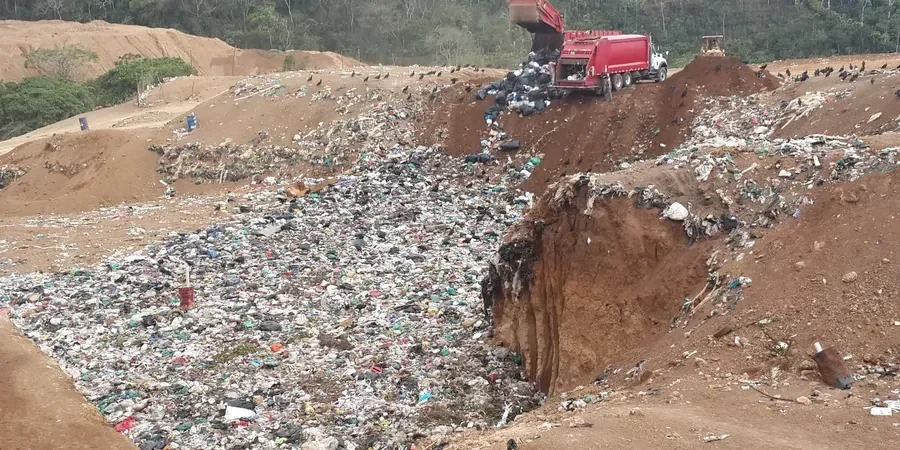
Derby's glacial till over Mercia Mudstone creates variable settlement profiles that directly affect landfill gas management and liner integrity.
Process overview
- Borehole drilling through waste to natural ground
- In-situ gas monitoring wells
- Leachate sampling and chemical analysis
- Plate load testing on engineered capping layers
Local context
Under Eurocode 7 (BS EN 1997-1:2004) and the UK Landfill Regulations, the key risk in Derby is uncontrolled differential settlement that ruptures the geomembrane liner or damages the gas extraction system. The Mercia Mudstone can contain gypsum-rich horizons that, if exposed to leachate, cause sulfate attack on concrete structures. We always include chemical testing on both the waste and the underlying natural ground to rule out aggressive ground conditions before any capping or foundation work proceeds.
Regulatory framework
BS EN 1997-1:2004 (Eurocode 7), BS 5930:2015 (Code of practice for ground investigations), Environment Agency LFE6 (Landfill lining and capping guidance)
Additional services
Waste Mass Characterisation
Borehole drilling through waste with continuous sampling to determine composition, density, and gas potential. Includes in-situ gas monitoring and leachate sampling for chemical analysis.
Liner and Capping Design
Geotechnical design of mineral and geosynthetic liners, including permeability testing, interface shear strength assessment, and settlement analysis to ensure long-term containment performance.
Slope Stability Analysis
Stability assessment of waste slopes and containment bunds using limit equilibrium methods. Considers short-term undrained conditions and long-term drained behaviour with gas pressure effects.
Typical parameters
Questions and answers
What does a landfill geotechnics investigation in Derby typically involve?
A standard investigation includes drilling boreholes through the waste mass to natural ground, installing gas and leachate monitoring wells, and collecting samples for laboratory testing. We also perform trial pitting at the perimeter to confirm liner conditions and run chemical tests on both waste and groundwater.
How much does a landfill geotechnics study cost in Derby?
Costs typically range from £1,880 to £7,400 depending on the site area, number of boreholes, and the extent of laboratory testing required. A small closed landfill with a single borehole and basic chemical suite sits at the lower end, while a large active site with multiple wells and advanced gas modelling reaches the upper end.
What regulations apply to landfill geotechnics in the UK?
The main regulatory framework includes the Environmental Permitting Regulations, the Landfill Directive, and technical guidance from the Environment Agency. Geotechnical design follows Eurocode 7 (BS EN 1997-1:2004) and BS 5930:2015 for ground investigation procedures.
How long does a landfill geotechnical investigation take?
A typical investigation for a medium-sized site in Derby takes 4 to 8 weeks from mobilisation to final reporting. Drilling and monitoring well installation usually takes 1–2 weeks on site, followed by 3–6 weeks for laboratory testing and data interpretation.