Derby's industrial expansion during the 18th and 19th centuries, driven by the railway and silk industries, shaped much of its urban layout. Many Victorian-era structures along the Derwent and Trent floodplains now require deep foundations that rely on pile skin friction and end bearing for load transfer. The local geology, dominated by alluvial deposits over Mercia Mudstone, makes understanding the balance between shaft resistance and base capacity critical for safe foundation design. For projects in central Derby, we often combine this analysis with a clasificación de suelos to classify underlying strata and a cimentaciones superficiales assessment to compare shallow and deep foundation options.
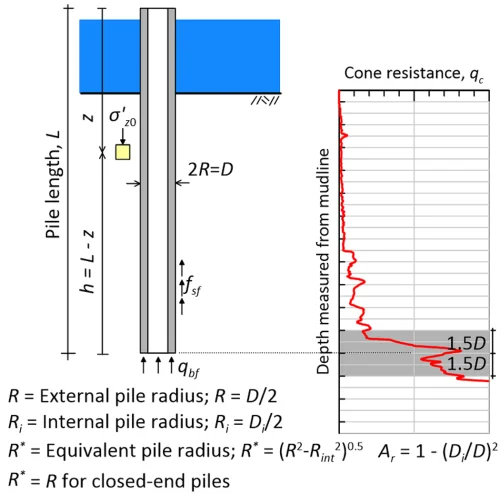
In Derby's Mercia Mudstone, shaft friction often mobilises at 0.5% shaft diameter movement, while base resistance requires 5–10% movement to fully activate.
Process overview
Local context
Derby sits at an elevation of about 60 metres above sea level, with the city centre prone to groundwater levels within 2–3 metres of the surface. This shallow water table reduces effective stress in the soil, lowering both skin friction and end bearing capacity. In our track record, ignoring the pore pressure response during pile driving in Derby's alluvial clays can lead to overestimated shaft resistance by 30–40%. The risk is particularly acute near the River Derwent, where laminated silts and organic layers can cause rapid load transfer to the base if skin friction is overestimated. A proper pile skin friction vs. end bearing analysis mitigates this by separating the two components during the test.
Regulatory framework
BS EN 1997-1:2004 (Eurocode 7 – Annex D for pile load testing), BS 5930:2015 (Code of practice for ground investigations), BS 1377/D1143M-20 (Standard test method for piles under static axial compressive load)
Additional services
Static Pile Load Test
Full-scale maintained load test using hydraulic jack and reaction frame, measuring skin friction and base resistance separately via strain gauges along the pile shaft.
Osterberg Cell (O-Cell) Test
Bi-directional load test ideal for large-diameter piles, isolating shaft and base components without the need for a reaction frame in constrained Derby sites.
Pile Integrity Testing (PIT)
Low-strain impact test to assess pile continuity and shaft condition, used as a preliminary check before detailed skin friction analysis.
Numerical Modelling (FEM)
Finite element analysis using PLAXIS 2D to simulate pile-soil interaction, predicting skin friction and end bearing under working and ultimate loads.
This service complements our laboratory testing work for a complete project analysis.
Typical parameters
Questions and answers
What is the difference between pile skin friction and end bearing?
Skin friction is the load carried by the pile shaft through shear resistance along the soil-pile interface. End bearing is the load transferred to the base of the pile through the soil or rock beneath it. In Derby's Mercia Mudstone, skin friction often contributes 60–70% of total capacity for cast-in-place piles.
How much does a pile skin friction vs. end bearing analysis cost in Derby?
The typical cost for a static pile load test with skin friction separation ranges from £790 to £2,670, depending on pile diameter, test depth, and site access. This includes mobilisation, instrumentation, and a full report.
When should I use an Osterberg cell test instead of a conventional static load test?
An O-Cell test is recommended when head room is limited, or when testing very high-capacity piles where a reaction frame would be impractical. In Derby's floodplain sites, we often use O-Cells for piles exceeding 1,200 kN capacity to avoid building temporary works.
What ground conditions in Derby most affect pile skin friction values?
The alluvial clays and laminated silts along the River Derwent reduce skin friction due to low undrained shear strength (typically 20–40 kPa). Conversely, the Mercia Mudstone at depth provides shaft resistance values of 80–150 kPa, making end bearing dominant in deeper piles.