Derby’s urban growth since the 18th century has seen former railway yards, iron foundries, and textile mills replaced by housing and commercial districts. Much of this development sits on variable made-ground and alluvial terrace deposits over Mercia Mudstone. For large redevelopment plots, dynamic compaction design is often the most cost-effective method to densify deep fill and loose natural sands before foundations go in. We combine site walkover data with a phased testing programme. Before the drop sequence begins, we run a placa de carga on representative areas to establish baseline modulus values and calibrate the energy per drop. Our team then adjusts grid spacing, drop height, and number of passes to match Derby’s specific ground conditions – whether we’re dealing with 3 m of colliery spoil or 6 m of granular river terrace gravels.
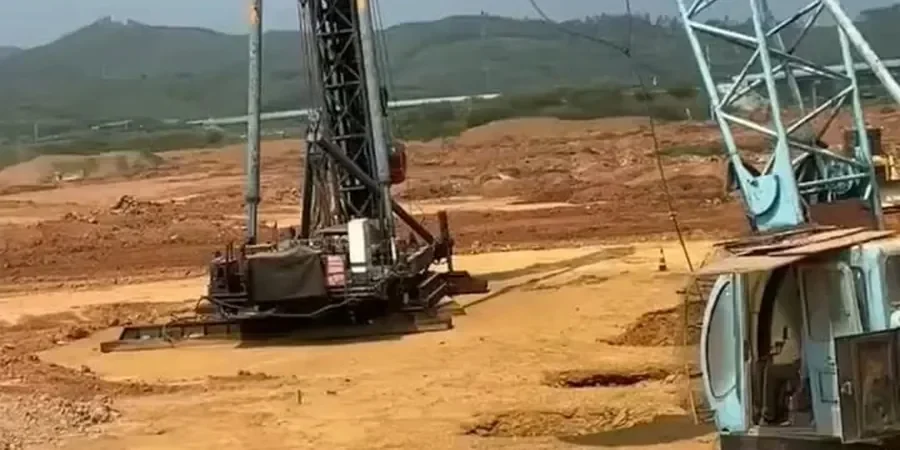
On Derby brownfield sites we typically achieve 50–70 % reduction in void ratio after two phases of dynamic compaction, bringing bearing capacity above 200 kN/m².
Process overview
- Drop energy: 150–300 t·m per impact (tamper mass 10–20 t, drop height 15–20 m)
- Grid spacing: 4–8 m square pattern, 2–3 phases
- Target densification: relative density > 70 % or blow count N₁₆₀ > 15
- Monitoring: settlement plates, inclinometers, and before/after ensayos SPT at 1 m intervals
Local context
We worked on a 3‑ha site off Pride Parkway where 5 m of railway ash and demolition rubble overlay loose sand and gravel. The client wanted a 12‑m deep treatment zone for a warehouse slab. After the first pass, crater depths reached only 0.6 m instead of the predicted 1.2 m. We stopped the sequence, ran a georradar GPR survey, and found a buried concrete foundation at 3 m that was absorbing energy. We relocated the grid, removed the obstruction, and completed the second pass with full penetration. The risk of hidden obstructions in Derby’s industrial fill is high – you cannot rely on desk studies alone.
Regulatory framework
BS EN 1997‑2 (Eurocode 7 – Ground investigation and testing), BS 5930:2015 (Code of practice for site investigations), CIRIA Report C573 (Dynamic compaction – design and specification)
Additional services
Design & specification of drop programme
We define tamper mass, drop height, grid geometry, and number of passes based on target depth, fill type, and adjacent structures. Deliverables include a phased compaction plan, settlement monitoring layout, and pass‑by‑pass quality control criteria.
Pre- and post-treatment testing
We run SPT, cone penetration tests (CPT), and plate load tests before and after compaction. Results are compared with the design criteria to confirm that target density and modulus have been achieved across the entire treatment footprint.
Typical parameters
Questions and answers
What depth of fill can dynamic compaction treat in Derby?
Typical treatment depths range from 4 m to 10 m in granular fills and loose sands. Deeper treatment (up to 12 m) is possible with high-energy tampers (20 t, 20 m drop) but requires careful assessment of groundwater and buried works. For depths less than 4 m, vibro-compaction or surcharging may be more economical.
How is dynamic compaction different from vibro-compaction?
Dynamic compaction uses a falling weight to impart high-energy impacts to the ground surface, densifying fill and loose natural soils to depths of 8–12 m. Vibro-compaction uses a vibrating probe inserted into the ground and is more effective in clean sands at depths up to 20 m. Dynamic compaction works better on mixed fills containing rubble, ash, and clay lumps – typical of Derby’s brownfield sites.
What is the typical cost range for dynamic compaction design in Derby?
For a medium-size brownfield plot (1–3 ha), the design and specification fee typically ranges from £1,050 to £3,100 depending on the complexity of the fill, number of passes, and monitoring requirements. This excludes the cost of the compaction contractor but includes site visit, parameter calculation, monitoring plan, and validation testing scope.