Eurocode 7 (EN 1997-1:2004) is the governing standard for raft foundation design in Derby, and for good reason. The city sits on a complex mix of alluvial deposits from the River Derwent and glacial tills from the last ice age. Some areas feature firm clays over mudstone, while others have sand and gravel layers with high groundwater. A properly designed raft slab spreads structural loads evenly across these variable layers, minimising differential settlement. We routinely combine raft analysis with cimentaciones-superficiales to compare shallow options, and use asentamientos predictions to verify long-term performance.
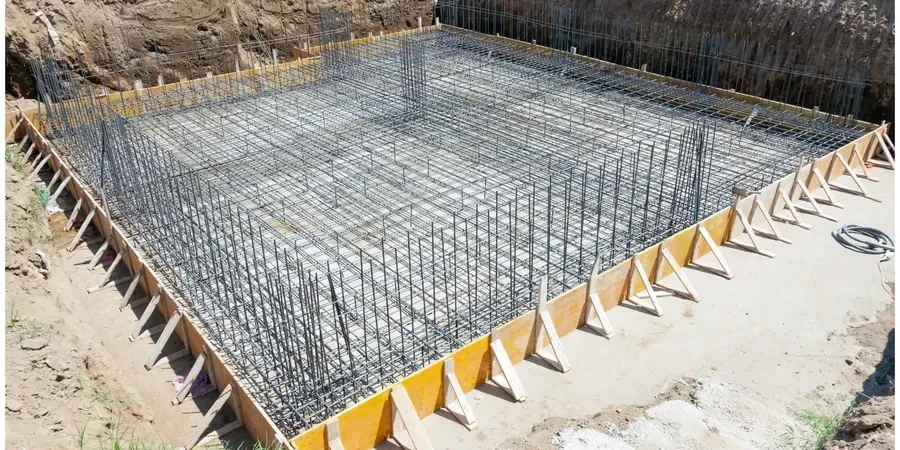
A raft foundation spreads structural loads across variable Derby ground, reducing differential settlement risk without deep piling.
Process overview
Local context
We saw a three-storey office block in Derby city centre where the original design used isolated footings on made ground. After two months the building had cracked internally. We stepped in and redesigned a raft foundation that tied the columns together, spreading loads over the soft alluvial clay. The slab was stiffened with edge beams and cast directly onto a compacted granular layer. That project taught us: never assume uniform ground in Derby. The geology changes block by block. A raft foundation is often the safest call when made ground or variable till is present.
Visual overview
Regulatory framework
Eurocode 7 (EN 1997-1:2004), BS 5930:2015 (Code of practice for ground investigations), BS EN 1992-1-1 (Concrete design), NHBC Standards Chapter 4.2 (Building near trees)
Additional services
Site Investigation for Rafts
We drill boreholes, take undisturbed samples, and run lab tests to determine soil stiffness and groundwater conditions. The data feeds directly into the raft design model.
Finite Element Analysis
Using geotechnical software, we simulate the raft interaction with Derby soils. We check bending moments, shear forces, and differential settlement across the slab.
Reinforcement Detailing
We produce full reinforcement drawings and bar bending schedules. The design accounts for punching shear at column locations and thermal cracking control.
Typical parameters
Questions and answers
Is a raft foundation suitable for Derby's clay soils?
Yes, provided the clay is stiff or firm and the groundwater is managed. Derby's glacial tills and some alluvial clays can support a raft if the bearing capacity is verified by SPT tests and the slab is stiffened with beams. For very soft clays, Improvement or a piled raft may be needed.
How long does a raft foundation design take?
A typical residential raft design takes 2 to 4 weeks from borehole completion. Commercial projects with larger slabs and more complex loading may take 6 to 8 weeks, including the site investigation and lab testing phase.
What is the difference between a raft and a strip foundation?
A raft foundation is a continuous concrete slab that supports the entire building. Strip foundations are narrow concrete strips under load-bearing walls. Rafts are better for weak or variable ground because they spread loads more evenly and reduce differential settlement. In Derby, rafts are common on made ground or soft alluvial deposits.
How much does a raft foundation design cost in Derby?
The geotechnical design fee typically ranges between £840 and £3,370 depending on the site area, number of boreholes required, and complexity of the soil profile. This includes the desk study, field investigation, lab testing, and the final design report.