The Derbyshire landscape presents a unique mix of steep valley sides, glacial till deposits, and variable sandstone strata. Heavy rainfall across the East Midlands saturates these slopes, reducing effective stress and triggering shallow failures. A solid slope stabilization design in Derby must account for perched water tables and the low shear strength of Coal Measures clay. Before committing to reinforcement, engineers verify soil parameters through ensayo triaxial to obtain drained strength envelopes. Combining this data with piezometric records allows calculation of factor of safety under worst-case infiltration scenarios, a critical step for any development near the River Derwent or the A38 cutting.
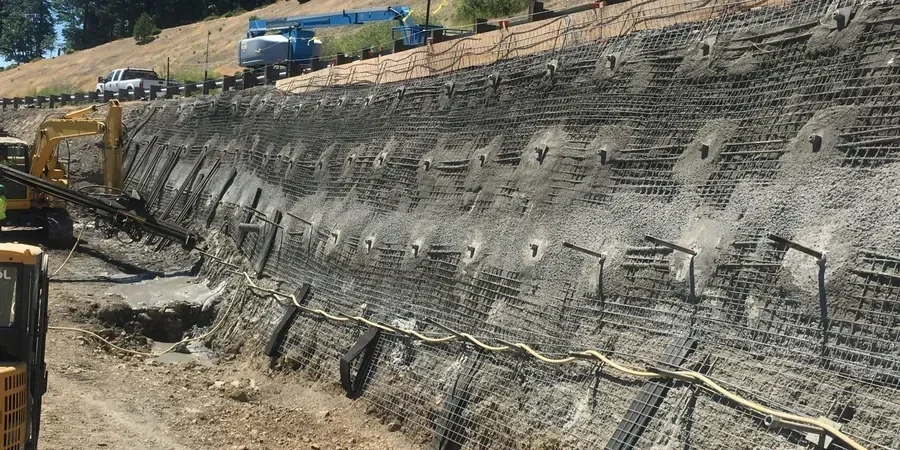
Slope failures in Derbyshire clay fills often occur after 48 hours of sustained rainfall, when perched water tables rise above the failure plane.
Process overview
Local context
A common oversight in Derby construction projects is neglecting the role of fissured clay infill within rock joints. Contractors assume intact rock strength governs stability, but the actual failure surface follows pre-existing discontinuities. Without a structural geology survey, the slope stabilization design in Derby underestimates wedge failures along bedding planes. This can lead to sudden collapse during excavation, endangering personnel and delaying programmes. A thorough discontinuity analysis, combined with shear box tests on infill material, prevents these surprises.
Regulatory framework
BS 5930:2015 (Code of practice for ground investigations), Eurocode 7: BS EN 1997-1:2004 (Geotechnical design), FHWA-NHI-05-089 (Soil nail walls – reference manual), Highways England Manual of Contract Documents (MCHW) – Volume 1
Additional services
Field investigation and instrumentation
Boreholes, trial pits, and installation of inclinometers and piezometers to define stratigraphy and groundwater regime.
Limit equilibrium and finite element modelling
2D and 3D stability analysis using Slide and PLAXIS, calibrated with site-specific strength parameters.
Remedial solution design
Soil nailing, anchored retaining walls, drainage blankets, and rockfall protection systems specified to Eurocode 7.
Construction monitoring and validation
Real-time displacement tracking during earthworks, verification of design assumptions, and as-built documentation.
Typical parameters
Questions and answers
What is the typical cost range for a slope stabilization design study in Derby?
For a standard residential or small commercial site, the geotechnical investigation and design package ranges between £1.340 and £4.430. This includes site visits, laboratory testing, numerical analysis, and a detailed report. Larger or more complex slopes with deep-seated failure potential may exceed this range.
How long does a slope stability investigation take in Derby?
A typical programme runs from three to six weeks, depending on access, weather, and the depth of investigation. Borehole drilling and piezometer installation require two to three days, followed by laboratory testing (one to two weeks), and then modelling and reporting (one to two weeks).
What is the difference between soil nailing and anchored walls for slope stabilization?
Soil nailing uses closely spaced, passive steel bars grouted into the ground to create a reinforced soil mass. Anchored walls employ pre-stressed tendons that transfer load to a stable stratum behind the failure surface. Soil nailing suits shallow (up to 10 m) cuts with competent soil; anchored walls are preferred for deeper slopes or where strict deformation limits apply.