Derby grew fast during the Industrial Revolution, with mills and railway works built directly on the river terraces of the Derwent. That early expansion means many central sites sit on alluvial deposits over Mercia Mudstone, a layered sequence that can amplify ground motion unpredictably. We routinely perform seismic amplification analysis for Derby projects, measuring shear-wave velocity profiles and classifying sites per Eurocode 8. Before we model the shaking, we often run a MASW survey to map velocity contrasts across the site, which gives us the Vs30 values needed for a reliable response spectrum.
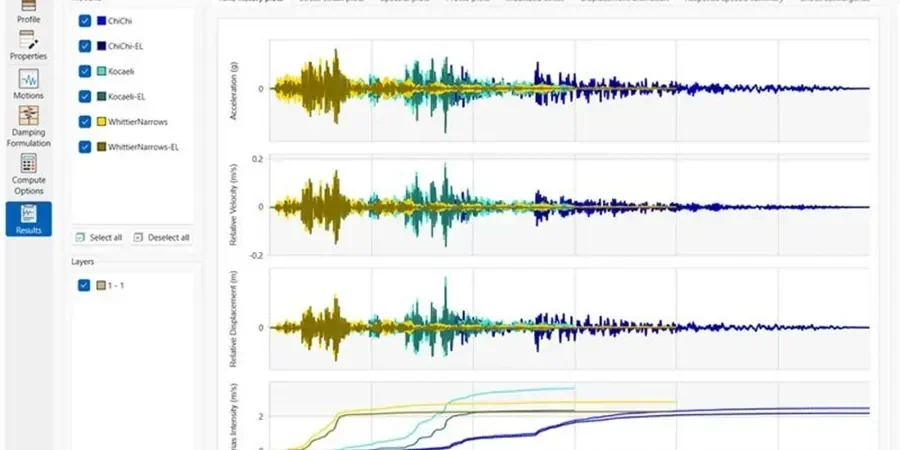
In Derby’s alluvial fills, a measured Vs30 of 250 m/s can double spectral acceleration compared to a rock site. We quantify that difference for safe design.
Process overview
- Vs30 profiling via MASW or ReMi to determine NEHRP site class (A–E)
- Site-specific response spectra per BS EN 1998-1 and UK National Annex
- Liquefaction susceptibility screening using fines content and SPT blow counts
Local context
In Derby, many times we see shallow fills and soft alluvium that were never compacted to modern standards. Those layers amplify low-frequency motion, which is exactly the range that can damage two-to-four-storey masonry buildings common in the city centre. Without a proper seismic amplification analysis, the design spectrum might underestimate the true demand by 30% or more. We also find that the Mercia Mudstone, despite being bedrock, has a weathered zone up to 6 m thick that lowers Vs significantly — ignoring that zone leads to unconservative foundation design.
Regulatory framework
BS EN 1998-1:2004 (Eurocode 8 – seismic actions), UK National Annex to BS EN 1998-1, NCHRP Report 611 (MASW procedures for Vs30), NEHRP site classification (FEMA P-749)
Additional services
Vs30 Profiling & Site Classification
MASW or ReMi surveys across Derby sites to measure shear-wave velocity to 30 m depth. We classify each location per Eurocode 8 and NEHRP, delivering a clear site class and fundamental period (T_site).
Site-Specific Response Spectra
Using the measured Vs profile and the UK National Annex, we generate elastic response spectra for 475-year and 2475-year return periods. The analysis accounts for soil nonlinearity and basin effects specific to the Derwent Valley.
Liquefaction & Ground Failure Screening
We combine SPT blow counts, fines content, and cyclic stress ratios to assess liquefaction potential under design earthquakes. For Derby’s alluvial sands, we flag zones where Improvement (e.g., vibrocompaction) may be needed before foundation work.
Typical parameters
Questions and answers
When is a seismic amplification analysis required in Derby?
It is required for all buildings in seismic design categories II, III, and IV per BS EN 1998-1, and for any structure where the site soil class is D or E. In Derby, this applies to schools, hospitals, and multi-storey residential blocks on the alluvial terraces.
How much does a seismic amplification analysis cost in Derby?
The typical range is £720–£1,580 depending on site size, number of MASW lines, and whether lab testing for fines content is included. We deliver a fixed-price quote after a site walkover.
What is the difference between Vs30 and site class?
Vs30 is the average shear-wave velocity in the top 30 metres, measured in m/s. Site class (A through E) is the Eurocode 8 category derived from that Vs30 value, combined with soil thickness and plasticity. A Vs30 of 250 m/s typically gives site class D (deep alluvium).
Can you perform amplification analysis on a brownfield site?
Yes. Brownfield sites in Derby often have variable fill thickness and hidden obstructions. We adapt the MASW line spacing to avoid buried works and use shorter arrays where access is tight. The analysis still meets UK National Annex requirements for site classification.