We recently worked on a site near Derby's Cathedral Quarter where the client needed accurate permeability values for a deep basement excavation. The ground was a mix of weathered Mercia Mudstone and river terrace gravels — two materials with vastly different hydraulic behaviour. Running a laboratory permeability test (falling/constant head) was the only way to get reliable coefficients for dewatering design. Without those numbers, the temporary works contractor would have been guessing at pump capacity. In Derby, where the River Derwent floodplain meets older glacial deposits, you cannot rely on published tables alone. That's why we insist on site-specific lab testing for every project we support in the city.
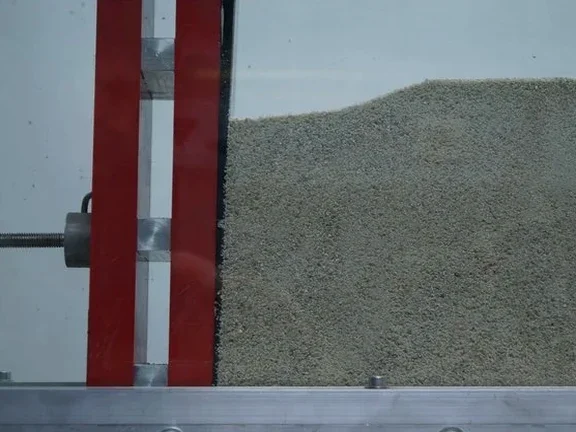
A single falling head test on Derby's weathered Mercia Mudstone revealed permeability two orders of magnitude higher than published values for intact rock.
Process overview
Local context
The biggest mistake we see in Derby is assuming that a standard soil report with Atterberg limits and moisture content is enough for dewatering design. Without a measured permeability coefficient, contractors often oversize pumps or, worse, undersize them. A basement excavation near the River Derwent that hit unexpected sand lenses flooded twice before the client called us. The falling head test on undisturbed samples from that site showed k values 100 times higher than the initial estimate. That delay cost more than the entire testing programme. In Derby, where groundwater fluctuates seasonally with the river stage, ignoring laboratory permeability testing is simply not an option.
Regulatory framework
BS 1377-6:1990 — Methods of test for soils: Consolidation and permeability tests in hydraulic cells, BS EN 1997-2:2007 (Eurocode 7 Part 2) — Ground investigation and testing, BS 1377-5-16a — Standard test methods for measurement of hydraulic conductivity of saturated porous materials using a flexible wall permeameter, BS 5930:2015 — Code of practice for ground investigations (Annex C on permeability)
Additional services
Falling Head Permeability Test
For fine-grained Derby soils: clays, silty clays, and weathered Mercia Mudstone. Uses a flexible wall permeameter with back-pressure saturation. Results include k at multiple confining stresses. Typical turnaround 7–10 working days.
Constant Head Permeability Test
For coarse soils: river terrace sands and gravels common along the Derwent valley. Rigid wall or triaxial cell setup. Test runs until steady-state flow is achieved. Suitable for drainage layer and filter design.
Typical parameters
Questions and answers
What is the difference between falling head and constant head permeability tests?
Falling head is used for low-permeability soils like Derby clays (k < 10⁻⁵ m/s) and measures the rate at which water drops in a standpipe. Constant head is for high-permeability soils like sands and gravels (k > 10⁻⁵ m/s) and maintains a steady hydraulic gradient throughout the test.
How much does a laboratory permeability test cost in Derby?
Typical cost for a falling head test is between £340 and £520 per sample, including sample preparation, saturation, and a full test report. Constant head tests are usually at the lower end of that range. Bulk discounts apply for multiple samples from the same project.
How long does it take to get permeability test results?
Falling head tests on Derby clays typically take 7–10 working days. Constant head tests on sands are faster — around 4–6 working days — because steady-state flow is reached more quickly. Urgent projects can be prioritised with a 48-hour surcharge.