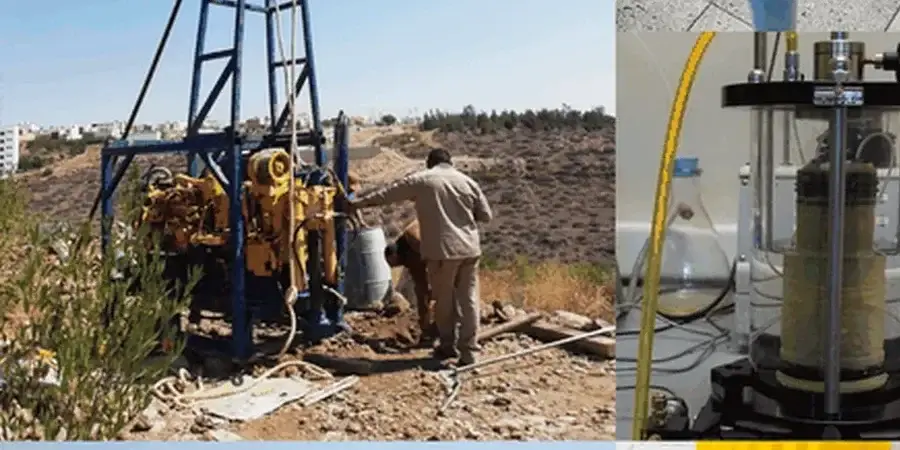
Our Derby office provides comprehensive geotechnical services across the East Midlands, combining consolidated regional experience with rigorous technical standards. We deliver integrated solutions for site characterization, foundation design, subsurface investigation, and construction monitoring, ensuring compliance with UK regulations. Our team supports projects ranging from residential developments to major infrastructure, coordinating closely with local authorities and contractors. Whether you require soil classification for preliminary assessments or advanced pavement subgrade design for transport schemes, we offer tailored, code-compliant reports using calibrated equipment. We are committed to safe, efficient, and sustainable ground engineering that addresses Derby's unique geological challenges.
Process overview
Local context
Our team brings consolidated regional track record in Derby's Mercia Mudstone and river terrace deposits, having delivered numerous projects across the East Midlands. We operate a UKAS-accredited laboratory with calibrated equipment for advanced testing, including direct shear and Atterberg limits, ensuring reliable data for design. Our engineers are proficient in UK codes, from Eurocode 7 to local authority guidelines, and coordinate seamlessly with contractors and councils to streamline approvals. This local knowledge, combined with a commitment to quality, underpins our ability to manage complex ground conditions efficiently.
Visual overview
Regulatory framework
Our work in Derby adheres to UK geotechnical standards, primarily Eurocode 7 (BS EN 1997) for geotechnical design, supported by British Standards like BS 5930 for site investigation and BS 1377 for laboratory testing. We also follow the National Annexes for UK-specific parameters. For field testing, we use procedures such as BS EN ISO 22476-2 for SPT and BS EN ISO 17892 for soil classification. These codes ensure solid, consistent evaluations for foundation design, slope stability, and earthworks, aligning with local building control requirements.
Questions and answers
What are the typical foundation challenges for sites in Derby?
Derby's variable ground conditions, with shallow river terrace deposits over weathered Mercia Mudstone, often require careful foundation design. The mudstone's weathered zone can reduce bearing capacity, while high groundwater in gravel layers may necessitate dewatering or deep foundations. Shrink-swell behaviour in clay-rich areas also affects shallow footings. Our assessments address these issues through detailed site investigation and code-compliant solutions.
How does groundwater affect construction in Derby's river valleys?
Along the River Derwent and Trent, groundwater levels are typically high and fluctuate seasonally, often within 2 metres of the surface. This can cause instability in excavations, require temporary dewatering, and impact foundation choices such as raft or piled foundations. We monitor groundwater during investigations to inform safe design and construction methods, ensuring compliance with UK regulations.
Which UK standards govern geotechnical work in Derby?
Geotechnical work in Derby follows Eurocode 7 (BS EN 1997) for design, BS 5930 for site investigation, and BS 1377 for laboratory testing. These are complemented by UK National Annexes and local building control requirements. Adherence to these standards ensures all reports and designs are solid, consistent, and accepted by regulatory bodies.
What types of projects commonly require geotechnical services in Derby?
Common projects include residential housing developments, commercial buildings, road and rail infrastructure, and flood defence schemes along the Derwent. Many involve shallow foundations on river terrace deposits or deep foundations on mudstone, requiring thorough site characterization. We also support slope stability assessments for nearby Pennine foothills and pavement design for local roads.
Location and service area
We serve projects across Derby.