Derby's geological setting demands a rigorous approach to soil classification, especially when working with the river terrace deposits and glacial till that underlie much of the city. The British standard BS 5930 provides the framework for describing soils, while the USCS and AASHTO systems offer classification that directly informs foundation design and pavement thickness. In Derby, where mixed alluvial and boulder clay sequences are common, proper identification of fines content and plasticity is essential. Using a USCS/AASHTO approach, engineers can distinguish between cohesive and granular layers with confidence. This service integrates with laboratory methods such as Atterberg limits to define plasticity and particle size analysis for grading curves, both critical for classifying Derby's variable subsoils.
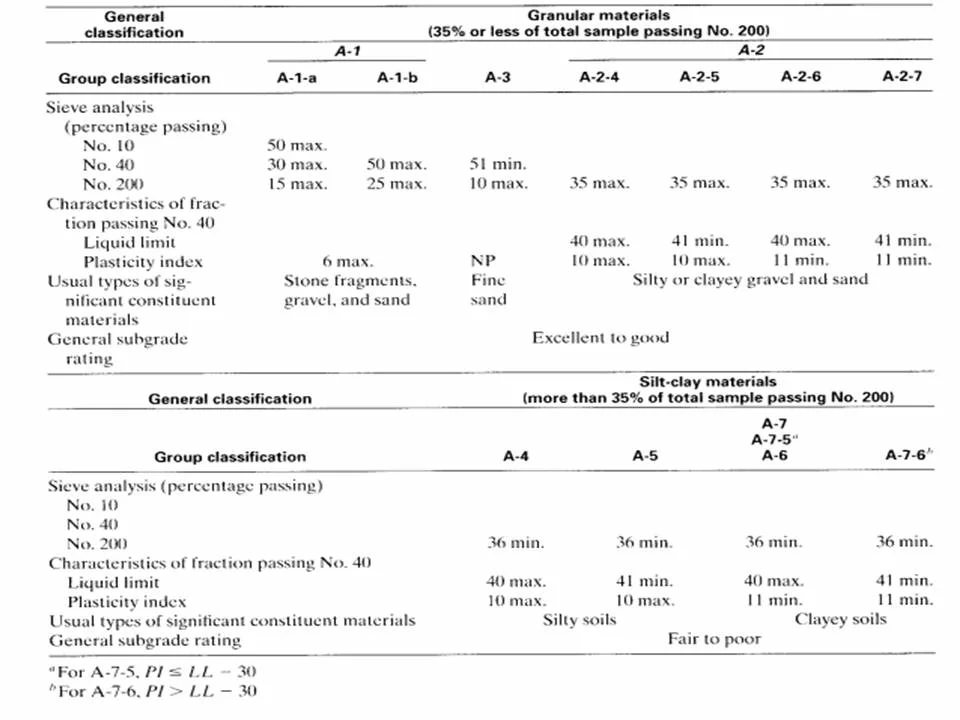
Derby's glacial till and river terrace deposits require systematic USCS/AASHTO classification to avoid misinterpreting bearing capacity across short distances.
Process overview
- Visual-manual description per BS 5930:2015+A1:2020
- Wet sieving and hydrometer analysis for particle size distribution
- Atterberg limits (liquid limit, plastic limit) for fine-grained soils
- USCS group symbol and AASHTO group index assignment
These steps produce a consistent classification that supports geotechnical models. For road projects, the AASHTO system directly links to pavement evaluation by predicting subgrade performance. For foundations, the USCS classification helps identify expansive clays or loose granular layers that require deeper analysis. Derby's ground often shows significant lateral variation, making systematic classification a prerequisite for reliable design.
Local context
Derby's geology includes low-lying alluvial areas near the River Derwent, where water tables can be shallow. In these zones, fine-grained soils with high plasticity (CH, MH) are common. Misclassifying these soils can lead to underestimating swelling potential or consolidation settlement. The glacial till, while generally stiff, contains lenses of sand and gravel that can cause differential behavior. Without proper USCS/AASHTO classification, foundation designs may not account for these transitions. Additionally, the city lies in a low seismicity region, but soil amplification from soft clays still needs evaluation. A correct classification reduces the risk of inadequate pavement design and foundation movement.
Regulatory framework
BS 5930:2015+A1:2020 Code of practice for ground investigations, BS EN 1997-2:2007 Eurocode 7 – Ground investigation and testing, BS EN ISO 14688-2 Standard Practice for Classification of Soils (USCS), AASHTO M 145-91 Standard Specification for Classification of Soils (AASHTO)
Additional services
Full USCS Classification with Laboratory Testing
Complete classification including particle size distribution, Atterberg limits, and natural moisture content. Results reported with group symbol and descriptive name per BS 5930.
AASHTO Classification for Pavement Design
Focused on road and airfield projects. Delivers group index and soil type rating for subgrade assessment. Includes CBR correlation where applicable.
Field Identification and Visual-Manual Classification
On-site logging of trial pits and boreholes. Experienced geologists describe soil fabric, colour, consistency, and structure. Samples selected for laboratory confirmation.
Typical parameters
Questions and answers
What is the difference between USCS and AASHTO soil classification?
USCS classifies based on particle size and plasticity, grouping soils into 15 main categories like CH, SM, or GW. AASHTO classifies primarily for pavement subgrade rating, using a group index from 0 to 20+ to indicate serviceability. Both are used in Derby projects: USCS for foundation design, AASHTO for road and highway work.
How much does a soil classification test cost in Derby?
A standard classification including sieving, Atterberg limits, and report typically costs between £50 and £70 per sample. Bulk discounts apply for multiple samples from the same site. Prices vary with project scope and required turnaround.
Which soil types are most common in Derby?
Derby's ground is dominated by glacial till (boulder clay) classified as CL or CH under USCS, along with river terrace gravels (GW, GP) and alluvial silts (ML). The till is often stiff but contains sand lenses. River terrace deposits are granular and well-draining. Proper classification distinguishes these layers for foundation design.